Lean Canvas: What It Is and How to Fill It In, Box by Box
A Lean Canvas puts a business idea on one page in nine boxes. What each box means, the order to fill them, a filled Israeli example and the first mistakes.
What is the Business Model Canvas
The Business Model Canvas is a one-page template of nine blocks that shows how a business creates value, delivers it and earns from it.
One café's canvas, and where the money meets
Revenue, one order
₪25
Costs, one order
₪22
Left from it
₪3
The order's costs: supplies ₪7, staff time ₪8, rent, equipment and software ₪7. The same café as on the business model page.
Value proposition: What problem do you solve, and why would a customer choose you? The café's answer: Good coffee and breakfast in under three minutes. This block brings the revenue in.
A Lean Canvas is a one-page template of nine boxes that turns a business idea into assumptions you can check: the problem, the customers, why they would choose you, the solution, how you reach them, where the money comes from, what it costs, which numbers show progress, and what nobody can easily copy. Ash Maurya created it in August 2010 as a startup version of the Business Model Canvas.
I am Alex Slutsker, a business consultant at Mobius Business Solutions, and I have run this exercise many times. Most people see only one part of their business and never the whole ecosystem around it. A Lean Canvas maps all of it on one sheet of A4.
What is a Lean Canvas?
A Lean Canvas is one page of nine boxes, each with a short note about one part of a business idea. Together the notes describe who has the problem, what you offer, how money comes in and goes out, and how you will know it works. Every note is a hypothesis (an assumption you still have to test), not a fact.
Ash Maurya, who created it, wrote that his main objective was to make the canvas "as actionable as possible while staying entrepreneur-focused." Each box answers one question:
| Box | The question it answers |
|---|---|
| Problem | Which one to three problems hurt the customer enough to act? |
| Customer segments | Who exactly has the problem, and who will buy first? |
| Unique value proposition | In one sentence, why you and not the alternatives? |
| Solution | What is the simplest thing that solves the problem? |
| Channels | How will customers hear about you and buy from you? |
| Revenue streams | What will they pay for, and how? |
| Cost structure | What will you spend money on? |
| Key metrics | Which few numbers show that the business is working? |
| Unfair advantage | What do you have that cannot be easily copied or bought? |
The current online version on LEANSpark, the tool of Ash Maurya's company LEANSTACK, adds three smaller fields inside those boxes: existing alternatives (how customers cope with the problem today), early adopters (the first customers who want it most) and a high-level concept (a one-line analogy that explains the idea fast).
How do you fill in a Lean Canvas?
Start with the problem and the customer segments. In my experience these are the two most important boxes, because everything else builds around them. A solution, a price or a channel means nothing until you know whose problem it solves. After those two, fill in the rest in an order where each box leans on the ones before it.
- Problem. Write the top one to three problems, and next to them how people cope with them today.
- Customer segments. Name the group that feels the problem most, and inside it the early adopters who would buy first.
- Unique value proposition. One sentence a stranger understands, about the result, not the features.
- Solution. The smallest thing that solves the problems in box 1. Three points at most.
- Channels. Where these customers already are, and how they will reach you.
- Revenue streams. What they pay for, once or on a recurring basis.
- Cost structure. The main costs of delivering the product and of reaching customers.
- Key metrics. Two or three numbers you will actually watch.
- Unfair advantage. Leave it empty if you have none yet. That is an honest answer.
One habit makes the page useful later: mark every note as a guess or as proven. On a first canvas almost everything is a guess, and that is the point. The canvas shows which guess to check first, and how to validate a startup idea with zero budget covers how to test it cheaply.
What does a filled Lean Canvas look like?
Here is an illustrative example: a fictional private math tutor in an Israeli city, with no real business and no market prices behind it. It shows the difference between notes too general to test and notes specific enough that a week of real conversations with parents could prove them wrong.
First, the too-general version. Customer segments: "students". Problem: "kids struggle with math". Channels: "social media". Every note is true, and none of them tells the tutor what to do on Monday morning.
Now the same idea, written to be tested:
- Problem: eleventh and twelfth graders in five-unit math (the highest level of high school math in Israel) fall behind in the months before the bagrut (Israel's matriculation exams), and parents often find out only after a weak mock exam. Existing alternatives: extra hours at school, a large tutoring center, free videos online, an older sibling.
- Customer segments: parents of five-unit math students in one city. Early adopters: parents whose child has just had a weak mock exam.
- Unique value proposition: one tutor from the first lesson to the exam, and a short written progress note to the parent every week.
- Solution: a fixed weekly lesson, the weekly note, and a practice exam once a month.
- Channels: recommendations in the parents' class WhatsApp groups, one parent telling another, a short listing on a local tutors' board.
- Revenue streams: a package of lessons paid before the exam period, and single lessons at a higher price per lesson.
- Cost structure: the tutor's hours, travel between homes, printed practice exams and the running costs of a registered business.
- Key metrics: how many families book a second package, and how many new families arrive through a referral.
- Unfair advantage: none yet. In a year, perhaps a circle of parents in one city who refer each other, which a newcomer cannot buy.
Now look for the riskiest note. Here it is the channel: will parents really recommend a tutor inside the class group? That is the first thing to check, before a single practice exam gets printed.
What is the difference between a Lean Canvas and a Business Model Canvas?
The Lean Canvas is Ash Maurya's startup adaptation of Alexander Osterwalder's Business Model Canvas. It keeps the one-page layout and swaps four boxes. Problem, solution, key metrics and unfair advantage come in. Key activities, key resources, customer relationships and key partners go out. The first tests a new idea, the second maps a whole business model.
Maurya explains the swap in his article on the choice. For an unknown startup with an untested product, he writes, "pursuing key partnerships from day one can be a form of waste." He folded customer relationships into channels, and he saw key activities and key resources as boxes that help outsiders understand what a startup does, rather than boxes that serve the founder.
So the choice depends on the question you are asking. If you are testing whether an idea deserves money, start with the Lean Canvas. If you need to see how a working business delivers, with its partners, suppliers and resources, the Business Model Canvas shows those parts better. Treating the two as the same tool is a common mistake.
How long does a Lean Canvas take?
A first sketch takes minutes. LEANSpark, the Lean Canvas tool of Ash Maurya's company LEANSTACK, promises a canvas in under five minutes. An honest canvas takes longer. In my lectures, with a good explanation and a good pace, an hour and a half is enough for a group to reach meaningful results.
The time is not the real measure, though. The point is not to fill in the canvas during the lecture and leave it there. It is a worksheet that stays with you. When a hypothesis turns out wrong, you fix it on the go, erase it, or add the elements you did not think of the first time.
What mistakes do people make the first time?
The most common mistake is writing too generally. Behind it sits a second one: not understanding what each box really means. The cost shows up later, when the owner tries to build an execution plan from the canvas and cannot, because the notes are too generic and too plain to act on.
- Too general. "Everyone" in customer segments, "good service" in the value proposition. A note nobody can prove wrong cannot guide a decision.
- Boxes filled by their label, not their meaning. The problem box gets a description of the product. The key metrics box gets vanity metrics (numbers that feel good but do not tie to revenue), such as followers, instead of repeat purchases.
- No execution plan. With vague notes the next step has nothing to stand on. The canvas looks finished, and the plan never starts.
Complete beginners make one more mistake, before any of these: they underrate the Lean Canvas itself. Many understand how much it matters too late, after they have already taken many actions that did not fit a whole understanding of their own business.
Can a Lean Canvas replace a business plan?
No. People sometimes call it a one page business plan and expect it to do the work for them. It will not. The canvas shows the logic of the business on one page. A business plan adds what the canvas leaves out: the numbers, the timing, the financing and the steps of execution.
What the canvas does is come before the plan. Before you plan your execution, make sure the execution fits the whole picture of the business. A plan built on a canvas with a missing box inherits the gap. For what a full plan contains and when you need one, read what a business plan is and when you need one.
Is a Lean Canvas only for startups?
It was built for startups. LEANSTACK's tool page says it focuses on what matters most at the early stage, while the Business Model Canvas maps an existing business as a whole. My view is broader: filling in a Lean Canvas is never the wrong move, even at a later stage, because it makes sure you do not miss anything.
In a business that already works you are not starting from zero. You already have proven hypotheses: customers who pay, a channel that brings them, a price they accept. Put those inside the canvas as they are, then add elements around them, the new hypotheses you want to check and prove. A new service, a new customer group or a new city each gets its own guesses, on the same page as the facts they rely on.
The one sentence to keep
If you remember one sentence from this article, make it this one:
Understand the whole ecosystem around your business, holistically, and do not focus only on specific elements.
Alex Slutsker, business consultant, Mobius Business Solutions
Building the first canvas for a new venture, and choosing which note to test first, is part of my consulting for startups. I also teach the Lean Canvas as a live exercise in lectures, and my talks for founders are listed under startup lectures. If you want a second pair of eyes on your canvas before you spend money on it, talk it through with me.
Sources
- Ash Maurya, "Why Lean Canvas versus Business Model Canvas", ashmaurya.com, the creator's own account of the canvas (August 2010) and of the four boxes he swapped, read 2026-09-26
- LEANSpark by LEANSTACK, the Lean Canvas tool page, leanspark.ai, the current box list, the free template and the early-stage framing, read 2026-09-26
The content on this blog is general information only and is not a recommendation to act. It is not business, legal, tax, or financial advice. Before making any decision, consult a qualified professional, such as an accountant, a lawyer, or a business advisor, about your specific situation.

Speaking at Microsoft

Meeting with international teams, as part of work with a startup
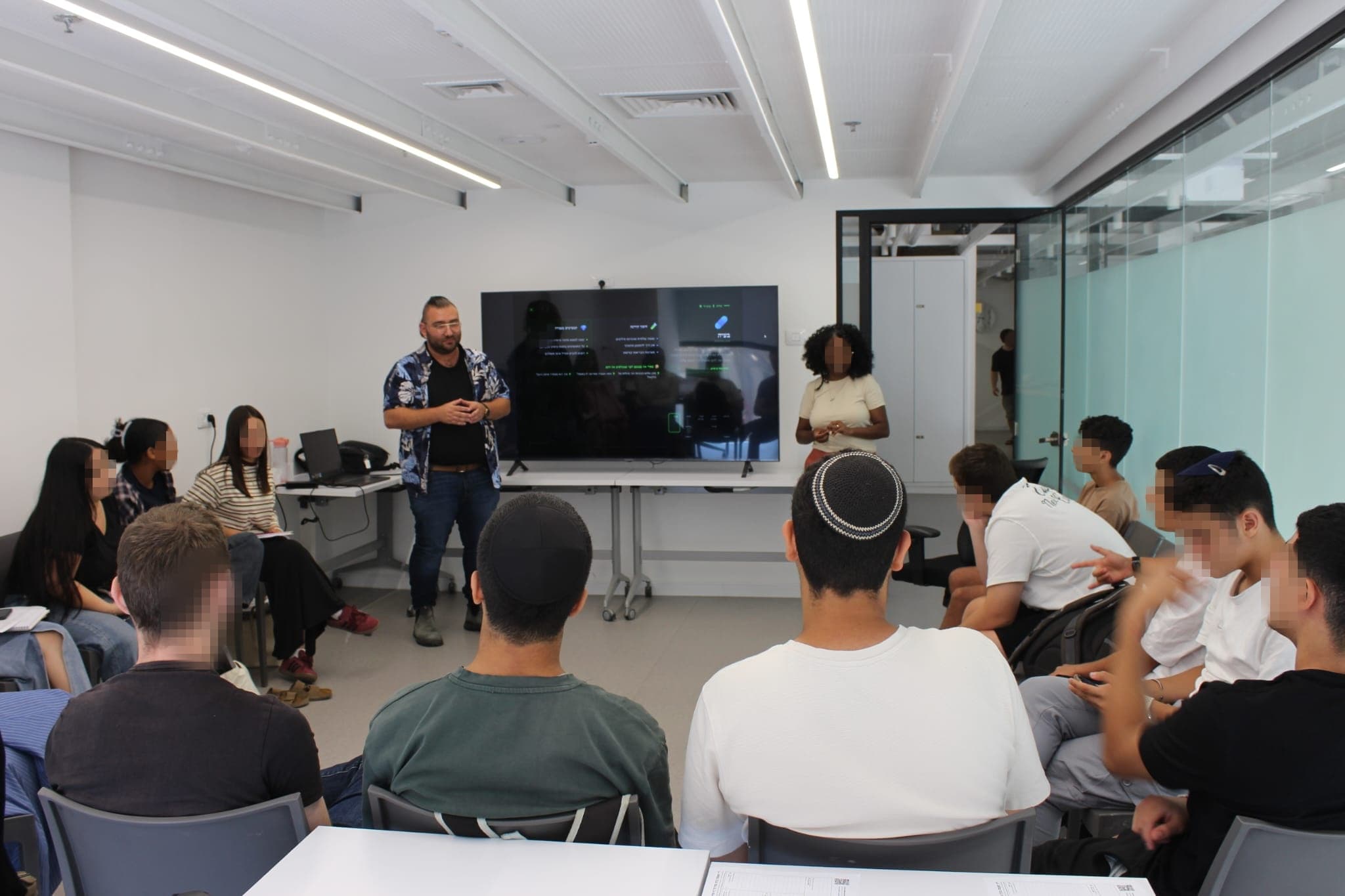
Teenovation, Meital centre Sderot

Entrepreneurs session, Sderot
I have worked with
- Google for Startups
- House of Business, Sderot Municipality
- Microsoft Reactor
- GameReady
- Eclipse Capital
- SderoTech
- IUCEL
- Resilience & Health Innovation Hub
- International Resilience Institute of Sderot
















- Google for Startups
- House of Business, Sderot Municipality
- Microsoft Reactor
- GameReady
- Eclipse Capital
- SderoTech
- IUCEL
- Resilience & Health Innovation Hub
- International Resilience Institute of Sderot
What Clients Say
From different fields, at different stages of business
Dan Manto
Eclipse Capital
Real Estate Investment and Finance, USA
Arty McLabin
GameReady
Game Development Education and Outsourcing, International

Anna
Beautician
After I finished a cosmetology course at a leading company, I was confused. I didn't know how to open a business, what to sell from home, or how to bring in clients. Since I reached out to Mobius, everything has changed. We built an organized plan with clear steps and no unnecessary risks. Today I see results, and I'm growing and developing every month.

Mark
Massage therapist, Gan Yavne
When I finished a massage course, I imagined a different world. I found out it's a hard field, and financial stability isn't easy to find. When I came to Mobius, something changed. We started an organized process and built a business plan. Without Mobius? I probably would have given up. Today I believe in myself and in my own path.
And the paperwork, for anyone who wants to see that too.

Certificate of appreciation, Sderot municipality

Certificate of honor, Teenovation 2026

Directors and officeholders course, SRI Campus

Acceleration program, MaofTech South

Business consultants course

Adaptive project management, INT college
Frequently asked questions
Should I fill in a Lean Canvas before I register a business?
Should I make one Lean Canvas per idea?
Can I fill in a Lean Canvas together with a partner?
Can I show my Lean Canvas to investors instead of a pitch deck?
My business already runs. How do I mark what is proven on the canvas?
Sales are dropping. Can a Lean Canvas show me why?
How often should I update my Lean Canvas?
Do I need both the Lean Canvas and the Business Model Canvas for a running business?
What does the word lean mean in Lean Canvas?
I cannot answer half of the boxes. Is that a bad sign?
Do I need to know finance to fill in the cost and revenue boxes?
Is there a free Lean Canvas template?
Terms from the business glossary
More Articles

Business, Marketing, Operations & Financial Consultant
Mobius
Alexander Slutsker
9+Years of experience in business consulting
I help entrepreneurs, self-employed people, small businesses and startups understand their own numbers, choose what to do first and grow from there.
Book a Call+972 055-248-6151. Better on WhatsApp: I am in meetings most of the day and answer as soon as I am free. Other ways to reach me