How to Open an Osek Patur or Murshe in Israel, Step by Step
Opening an osek patur or osek murshe in Israel: what to prepare, which office comes first, when to register, and the first advance payment that follows.
What is cash flow
Cash flow is the money coming into and going out of a business's account in a period.
Illustration
The first advance leaves before the first income
- Month 1₪13,500
- Month 2advance, no income yet₪10,993
- Month 3₪14,486
- Month 4₪17,979
- Month 5₪21,472
- Month 6₪24,965
- Fixed costs, ₪1,500 a month
- National Insurance advance, ₪1,007 a month
- Income from clients
On a declared ₪10,000 a month, the National Insurance advance is about ₪1,007 a month, billed from the month you register. The first client pays in month 3, so one advance payment of ₪1,007 in total leave before any income. The bank is lowest in month 2, at ₪10,993. The advance follows the ₪10,000 you declared, not the ₪6,000 that came in.
National Insurance only, on this post's 2026 rates for a self employed person aged 18 to retirement age: 7.7% of monthly income up to ₪7,703 and 18% above it. Income tax advances are a percentage of turnover the Tax Authority sets for your file, so ask your accountant. Savings, costs and income are illustrative.
To open an osek patur (VAT-exempt small business) or an osek murshe (VAT-registered business) in Israel, you open files with the Israel Tax Authority, for VAT and for income tax, and with the National Insurance Institute (Bituach Leumi). For a first-time filer, the National Insurance Institute says one digital process opens both. Registration is free, and the law sets the latest day to register as the day the business starts.
I am Alex Slutsker, a business consultant at Mobius Business Solutions. I do not open files myself, that is done with authorized specialists such as an accountant. My part is the timing, and what the business looks like on the day the file opens. Here is the order I recommend, and the payment that surprises new owners right after registration.
What do you need before you open an osek patur file?
Before any form, you need four answers: which status fits the business, the date the paid activity starts, what the business actually sells, and an honest estimate of your monthly income. The last one matters most, because the National Insurance Institute sets your payments on the income you declare.
Behind those four answers sits the real preparation, the part most people skip:
- A plan and its numbers. What you sell, at what price, and how many clients you need in a month to cover your costs.
- The people. Who you need around you to deliver, even if it is only a bookkeeper and one subcontractor.
- Suppliers. Who you will buy from, on what terms, and what the first order costs.
- The market. Real conversations with the people you expect to pay you. The method is in how to validate your business idea.
My rule is short: "Prepare the whole business around you first, and only after that open the business, meaning file the documents."
Which office do you register with first?
For a first-time filer the order barely matters. The National Insurance Institute says you can open your files with the Tax Authority and with National Insurance in one digital process. If you are already registered with the Tax Authority, National Insurance asks for form 6101 instead.
In practice the sequence looks like this:
- Choose the status. Osek patur or osek murshe, decided before registration. The full comparison is in osek patur or osek murshe: how to choose.
- Open the VAT and income tax files with the Israel Tax Authority. For an osek patur there is an online service.
- Open the self-employed file with the National Insurance Institute. Through the combined digital process, or with form 6101 if the Tax Authority already knows you.
- Declare your expected income honestly. This number sets your first National Insurance advance payments.
- Set up bookkeeping from day one, so every receipt from now on is in one place.
Where this step sits in the whole launch, from structure to first clients, is covered in the step by step checklist for opening a business in Israel.
When should you open the file: before or after you prepare the business?
Open it after the preparation and right before the first paid work. Most people do the opposite: they register first because it feels like the official start, and then begin to plan. The law only sets the latest day, the day the activity begins, not the earliest.
This is where I disagree with the common view. "People think they need the papers first and only after that they start the work. Once you open the files, you start prepaying taxes, paying the accountant and many other expenses, and that just wastes the momentum."
So my order is the reverse. "First make sure you have a business prepared, and only then file the documents. You can already work on closing things with your first clients. Just do not take the payment before the files are open."
The legal line is set by the VAT registration regulations: a person liable for VAT submits the registration form no later than the day he began his business or activity. Where exactly "began" falls in your case, for example whether a signed agreement already counts, is a question for your accountant, and it is worth asking before you sign.
One more habit for the preparation period: keep every receipt. Whether any of those expenses can be recognised once the file opens, and how far back, is again a question for your accountant, before you count on it. On the VAT side, section 40A of the VAT Law (read 2026-09-26) allows VAT paid before registration to be deducted only when the Tax Authority is satisfied that the purchases were made while setting up the business and served to set it up, an osek patur deducts no VAT anyway, and income tax judges pre-opening costs by rules of its own, so bring the receipts to your accountant rather than assume they will count.
What happens right after the file opens?
Advance payments start. These are mikdamot mas hachnasa (income tax advance payments) and mikdamot bituach leumi (National Insurance advance payments), payments on account of the year's tax and insurance. They have nothing to do with the deposits your clients pay you, even though Hebrew uses the same word for both.
The National Insurance Institute describes its side clearly:
- The amount comes from the income you declare when you open the self-employed file.
- It is billed monthly, for the previous month.
- You can ask to correct it once a quarter, if your income changed.
- The year is reconciled at the end. If you earned less than you paid on, the excess comes back. If you earned more, you pay the difference.
On the Tax Authority side, an income tax file usually carries its own advance payments, a percentage of turnover set for the file. Ask your accountant what yours will be before the first one is due.
For a business with little income yet, this is a cash flow (money moving in and out) problem from the first month. The payments are real cash going out while the cash coming in is still small.
How big is the first advance payment, and when does it arrive?
It arrives within weeks, not months, because National Insurance bills monthly for the previous month. Its size depends on the income you declared and on what the Tax Authority sets for your file. In my experience, "the first advance-payment demand can be a few thousand shekels", counting National Insurance and income tax together, usually over the first months. That is what I have seen, not a rule for your case.
To see how the declared income drives the National Insurance part, take the 2026 rates for a self-employed person between 18 and retirement age: 7.7 percent on monthly income up to 7,703 shekels, and 18 percent on the part above it, effective 1 January 2026. An illustrative calculation:
- Declared income of 5,000 shekels a month: about 385 shekels a month to National Insurance.
- Declared income of 10,000 shekels a month: about 593 shekels on the first 7,703, plus about 413 on the remaining 2,297, roughly 1,007 shekels a month.
Now compare that to the bank account of a business that has not invoiced anyone yet. That gap is why the timing of registration matters. How to budget the whole first year is in how much it costs to open a business in Israel.
Is opening an osek zeir a separate registration?
No. Osek zeir, formally baal esek zair (the micro-business regime), is an income tax track, not a third VAT status. You still register as osek patur or osek murshe for VAT, and a business that meets the conditions can use the micro-business regime for income tax on top of that status.
What the regime gives, a normative expense deduction and simplified reporting, and when it beats claiming real expenses, is explained in osek patur or osek murshe: how to choose. How and when you elect the regime for your file is a question to settle with your accountant at registration, not after the first annual report.
When should you skip osek patur and open straight as osek murshe?
When the law requires it, or when most of your expenses are materials with VAT on them. Some licensed professions cannot be osek patur at all. For everyone else, osek patur can be an advantage in the first contracts and payments, mostly when you sell to private clients, B2C (business to consumer).
"It depends on the law. Some professions are allowed to be zeir or patur, and there the smaller status can be an advantage for the first contracts, the first payments and the work with clients, mostly B2C. But when most of your expenses are materials, you need to show those bills to the accountant so they count against your revenue, and that is the most common reason to open as murshe first and not as one of the smaller ones."
The mechanism behind this is VAT. For income tax, both statuses deduct recognised business expenses. The difference is the VAT inside those purchases: an osek murshe deducts it from the VAT it collects, an osek patur cannot, so for a patur the VAT on every bag of materials is a final cost. A consultant whose main input is time loses little as a patur. A workshop that buys materials every week can lose a lot.
Which mistakes cost the most right after registration?
The costly mistakes right after registration are about the declared income and the timing: an optimistic income declaration, a file opened months before the first paid work, and an advance payment treated as the final bill. The first one usually costs the most in the first months, because it becomes a monthly payment.
The full list, all at the moment the file opens rather than in the earlier choice of status:
- Declaring an optimistic income. The advance payments follow the declared number, and a correction is possible only once a quarter. An inflated forecast becomes a monthly payment on money you have not earned.
- Opening the files months before the first paid work. From registration, the advances and the fixed costs of a running file start, while there is still nothing to invoice.
- Treating the advance as the final bill. The year is reconciled. If you earned more than you declared, the difference arrives as one payment, usually when you least planned for it.
- Taking payment before the file exists. The regulations set registration no later than the day the activity begins. A payment taken before that has to be sorted out afterwards with the accountant.
- Forgetting to update the declaration when income changes. Both directions cost money: overpaying ties up cash all year, underpaying builds a debt for the reconciliation.
The paperwork takes days, the preparation takes the work
Registration is the short part of opening a business. The long part is the plan, the numbers, the suppliers and the first clients, and the file should open when those are ready, not before.
That preparation is what I work on with owners in business launch support: checking the idea against real demand, the first price, the order of the first moves, and when to open the file so the first advance payment meets a business that already has clients. If you are about to register and want the timing checked against your real numbers, talk it through with me.
This article is general guidance, not tax advice. For a binding answer on your specific case, consult an accountant, the Israel Tax Authority or the National Insurance Institute.
Sources
- National Insurance Institute, opening a self-employed file (read 2026-09-26)
- National Insurance Institute, contribution rates for the self-employed, effective 1 January 2026 (read 2026-09-26)
- National Insurance Institute, how the self-employed pay (read 2026-09-26)
- National Insurance Institute, correcting advance payments (read 2026-09-26)
- VAT registration regulations, regulation 2(a)(2), Israeli law text on Hebrew Wikisource (read 2026-09-26)
- Value Added Tax Law, sections 40A and 52, Israeli law text on Hebrew Wikisource (read 2026-09-26)
- Israel Tax Authority, opening an exempt dealer file online
- Israel Tax Authority, questions and answers on the micro-business regime (baal esek zair)
- Kol Zchut, the Israeli rights portal, osek patur and the professions that must register as osek murshe
- Hebrew Wikipedia, osek patur, on income tax advance payments, a secondary source (read 2026-09-26)
The content on this blog is general information only and is not a recommendation to act. It is not business, legal, tax, or financial advice. Before making any decision, consult a qualified professional, such as an accountant, a lawyer, or a business advisor, about your specific situation.
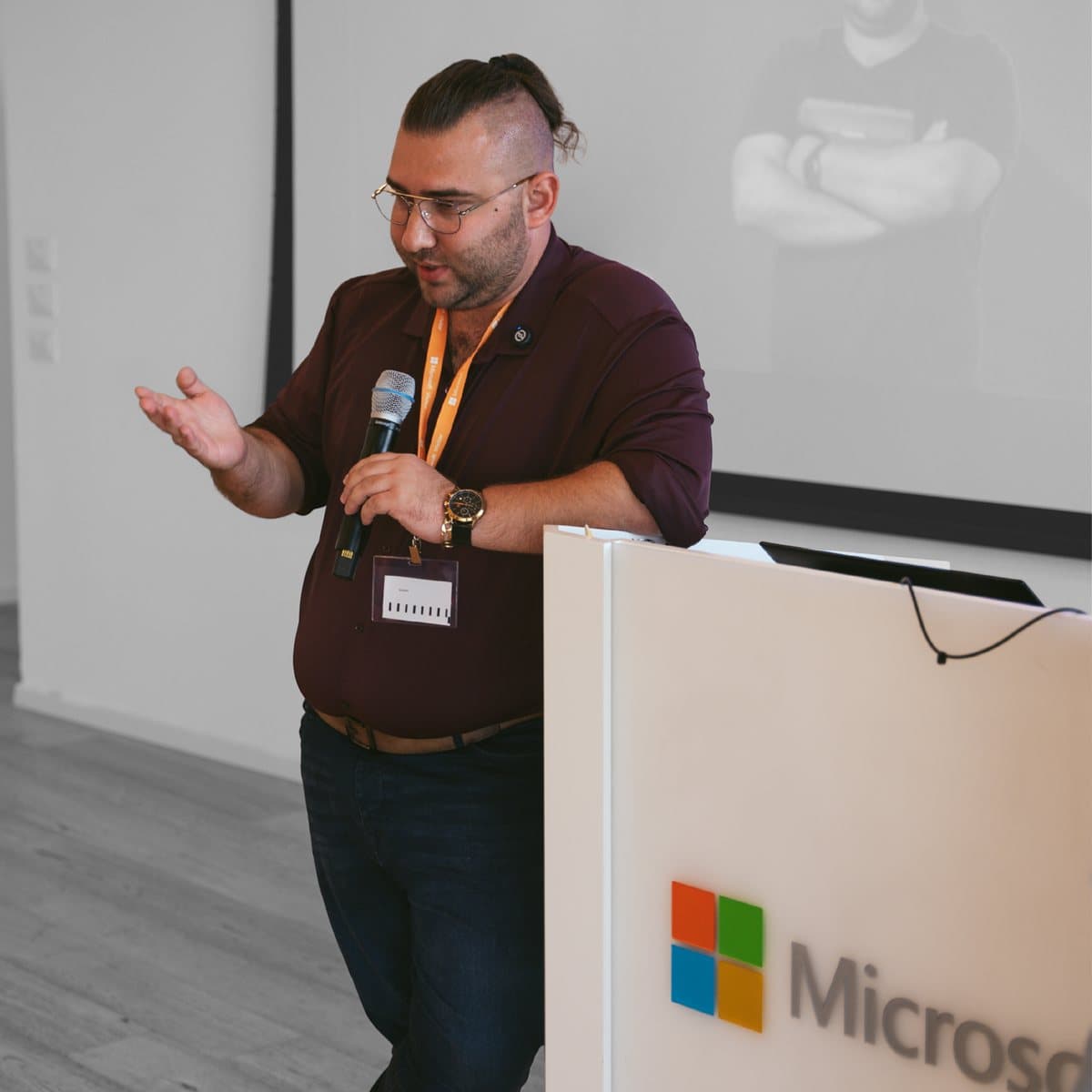
Speaking at Microsoft

Meeting with international teams, as part of work with a startup

Teenovation, Meital centre Sderot

Entrepreneurs session, Sderot
I have worked with
- Google for Startups
- House of Business, Sderot Municipality
- Microsoft Reactor
- GameReady
- Eclipse Capital
- SderoTech
- IUCEL
- Resilience & Health Innovation Hub
- International Resilience Institute of Sderot


















- Google for Startups
- House of Business, Sderot Municipality
- Microsoft Reactor
- GameReady
- Eclipse Capital
- SderoTech
- IUCEL
- Resilience & Health Innovation Hub
- International Resilience Institute of Sderot
What Clients Say
From different fields, at different stages of business
Dan Manto
Eclipse Capital
Real Estate Investment and Finance, USA
Arty McLabin
GameReady
Game Development Education and Outsourcing, International

Anna
Beautician
After I finished a cosmetology course at a leading company, I was confused. I didn't know how to open a business, what to sell from home, or how to bring in clients. Since I reached out to Mobius, everything has changed. We built an organized plan with clear steps and no unnecessary risks. Today I see results, and I'm growing and developing every month.
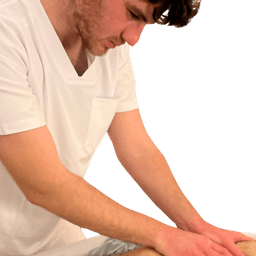
Mark
Massage therapist, Gan Yavne
When I finished a massage course, I imagined a different world. I found out it's a hard field, and financial stability isn't easy to find. When I came to Mobius, something changed. We started an organized process and built a business plan. Without Mobius? I probably would have given up. Today I believe in myself and in my own path.
And the paperwork, for anyone who wants to see that too.

Certificate of appreciation, Sderot municipality

Certificate of honor, Teenovation 2026

Directors and officeholders course, SRI Campus

Acceleration program, MaofTech South
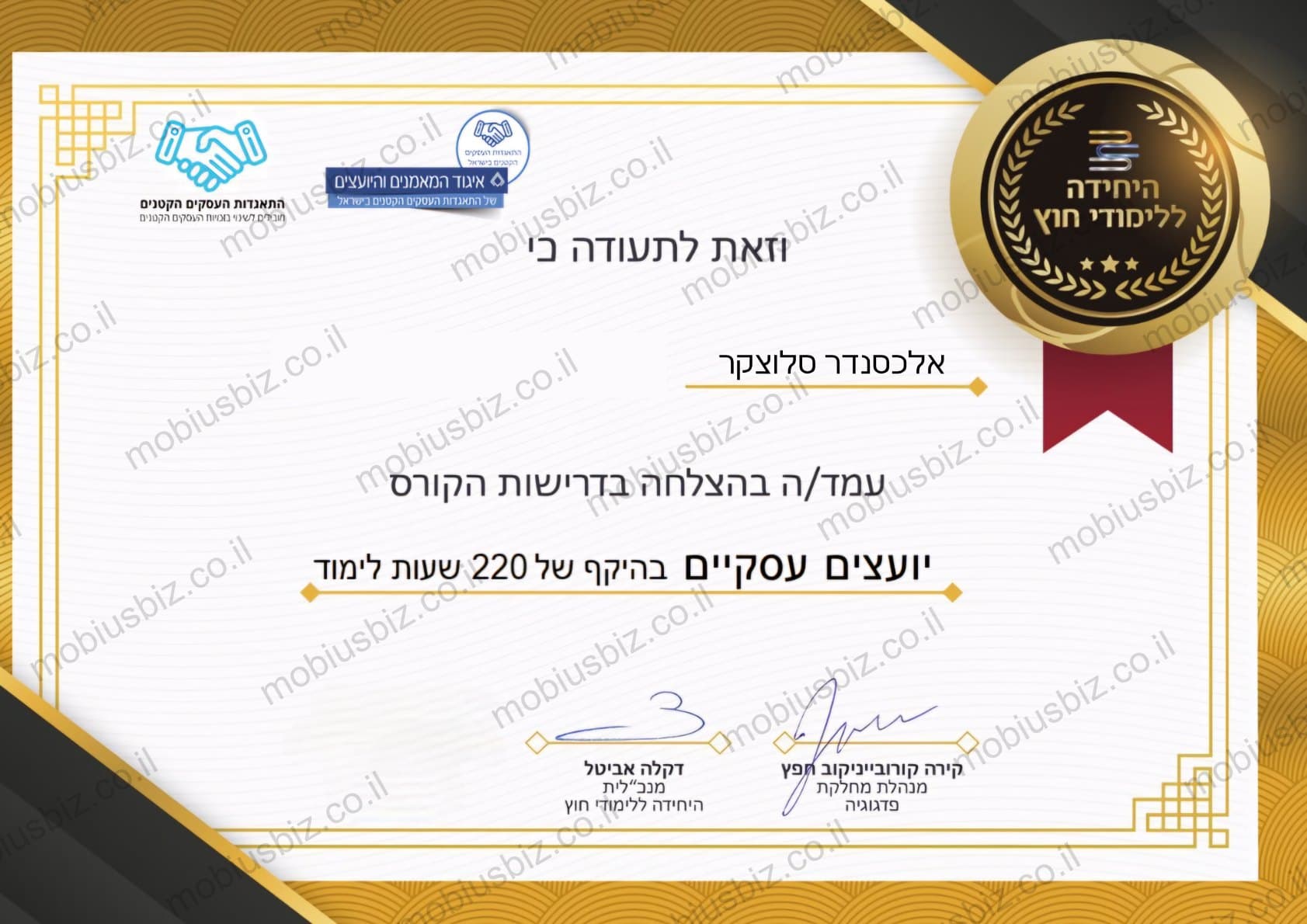
Business consultants course

Adaptive project management, INT college
Frequently asked questions
How long does it take to open an osek patur file?
Can I open an osek patur while I am still an employee?
Can I register as a business while I am still setting it up?
Do I need an accountant to open the file?
My National Insurance advance is too high for what I actually earn. Can I lower it?
Should I declare a low income to keep my advance payments small?
I already started working without opening a file. What now?
When and how do I pay the monthly National Insurance advance?
What is an advance payment in plain words?
Will I pay National Insurance if I earn almost nothing at first?
Is it risky to register if my business idea might not work?
What if I choose the wrong status when I register?
Terms from the business glossary
More Articles

Business, Marketing, Operations & Financial Consultant
Mobius
Alexander Slutsker
9+Years of experience in business consulting
I help entrepreneurs, self-employed people, small businesses and startups understand their own numbers, choose what to do first and grow from there.
Book a Call+972 055-248-6151. Better on WhatsApp: I am in meetings most of the day and answer as soon as I am free. Other ways to reach me