Why Marketing Fails: Fix the System, Not the Channel
Why small business marketing produces activity but not enough suitable leads, sales or profit, and the order to fix it: buyer, offer, follow-up, numbers.
What is a marketing funnel
A marketing funnel is a model of the stages people pass from first seeing your business to buying, and it shows at which stage most of them drop out.
Illustration
Where the Meta month leaks
- Impressions50,000
1% of the row above
Link clicks50020% of the row above
WhatsApp chats10050% of the row above · the biggest leak
Past the first reply5020% of the row above
Booked trial classes1050% of the row above
New members5
Half the chats get no answer for hours, so ₪3,000 makes 5 members at ₪600 each. An auto reply with the schedule lifts the reply stage to 80% and makes 8, before buying one more click.
Small business marketing usually fails as a system, not as a single campaign. The ad, post, landing page, WhatsApp reply, proposal, price, and follow-up all work together. If one part is unclear, the whole chain becomes expensive.
The most common mistake I see is buying activity before defining the economic problem. A business posts content, hires an agency, runs ads, or changes the design, but it still cannot answer a simple question: which buyer should take which next step, and why now?
The marketing and sales guide of the U.S. Small Business Administration (SBA) treats the target market, competitive advantage, sales plan, goals, budget, and ROI (return on investment) measurement as parts of one plan. It is a US framework, and the lens holds here too. Marketing should not be noise. It should move a defined buyer toward a measurable decision.
The channel is rarely the first diagnosis
When marketing disappoints, many owners immediately blame the platform. Facebook does not work. Google is too expensive. Instagram brings only curiosity. The agency is weak.
Sometimes that is true. More often, the channel is only exposing a deeper problem.
A familiar pattern: ads run for months, leads come in, and very few turn into sales. The owner blames the quality of the ads. The real problem usually sits further along the marketing funnel (the path from first contact to payment). The ads reach a very broad audience, including people without budget, authority, urgency, or a specific need.
The offer is often too general as well. It promises a general solution, and the buyer cannot quickly see which expensive problem it solves. Slow follow-up makes it worse. A new lead waits two days for a reply, and after the first call nobody knows what the next step is.
A better funnel often has fewer leads
The fix is rarely a bigger budget. Narrow the audience, rewrite the offer around one urgent problem, add simple qualification questions, and set a response rule, for example: new serious inquiries get a reply within one working hour whenever possible.
Lead volume may go down. That is not necessarily failure. What you want to see rise is the share of suitable leads and the quality of sales conversations, with less of the team's time spent on people who were never likely to buy.
This is why the first marketing question should not be "how many leads did we get?" It should be "how many suitable leads moved to the next decision?"
The numbers that expose failed marketing
I would start with a small set of numbers:
- suitable leads by source
- CPL (cost per lead), counted only for suitable leads
- first response speed
- conversion rate from lead to meeting
- meeting to proposal rate
- proposal to payment rate
- lost deal reasons
- gross profit by channel
For a small business, CAC (cost to win a customer) is useful only when it includes the real work behind the sale. Ad spend alone is not enough. Sales time, follow-up, content, agency fees, discounts, and margin all matter.
Recovery plan
If your marketing looks busy but does not sell, rebuild it in this order:
- Define one specific buyer, your ICP (ideal customer profile).
- Name one painful problem.
- Write one offer around a concrete result.
- Choose the channel where that buyer already pays attention.
- Decide who responds and how fast.
- Track one weekly conversion number.
- Review lost deals without ego.
For related fixes, read common marketing mistakes, customer journey mapping, and digital marketing on a tight budget.
Finding the real leak in the funnel, before more money goes into ads, is where marketing strategy consulting starts.
If you cannot see where your own leak is, show me your funnel.
The content on this blog is general information only and is not a recommendation to act. It is not business, legal, tax, or financial advice. Before making any decision, consult a qualified professional, such as an accountant, a lawyer, or a business advisor, about your specific situation.
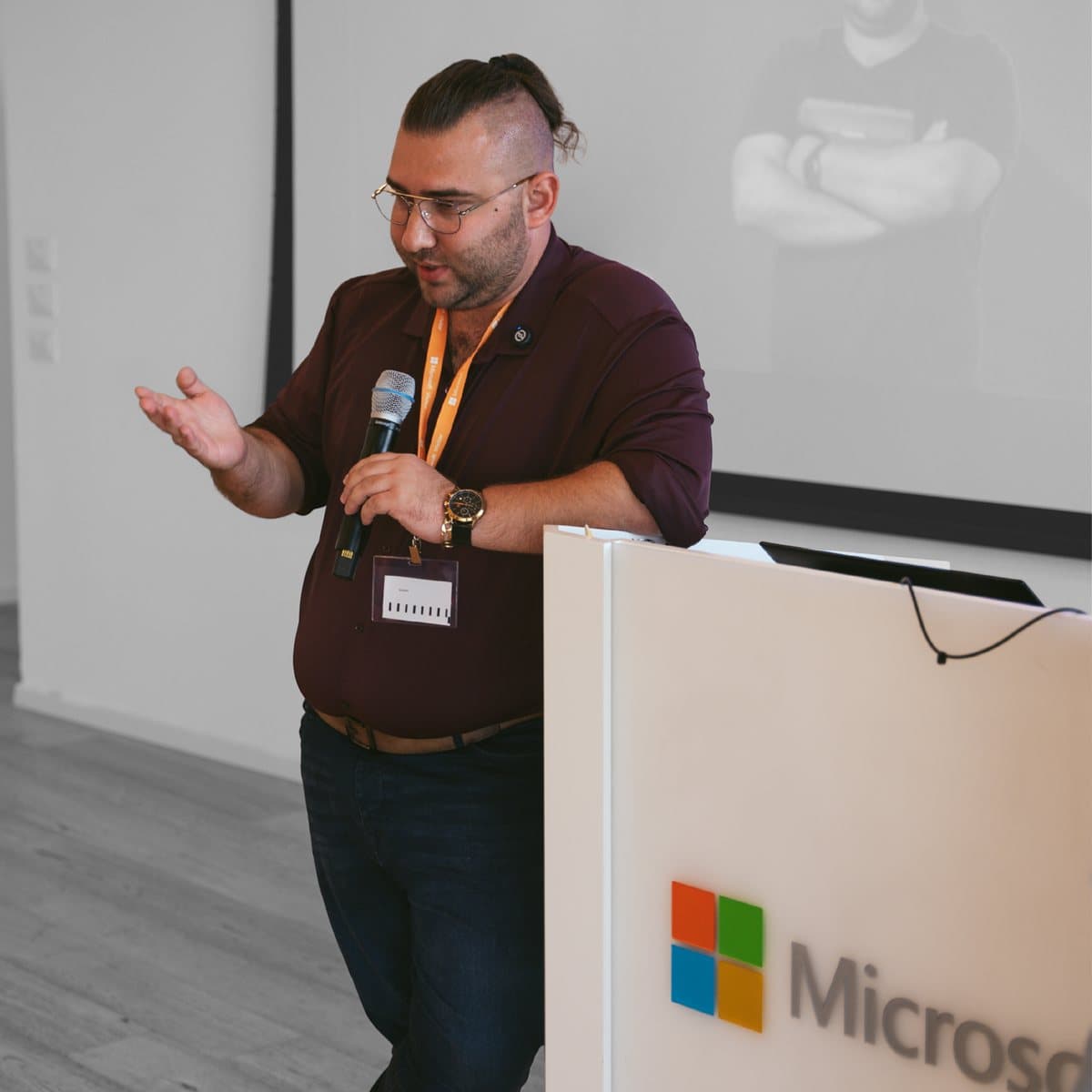
Speaking at Microsoft

Meeting with international teams, as part of work with a startup
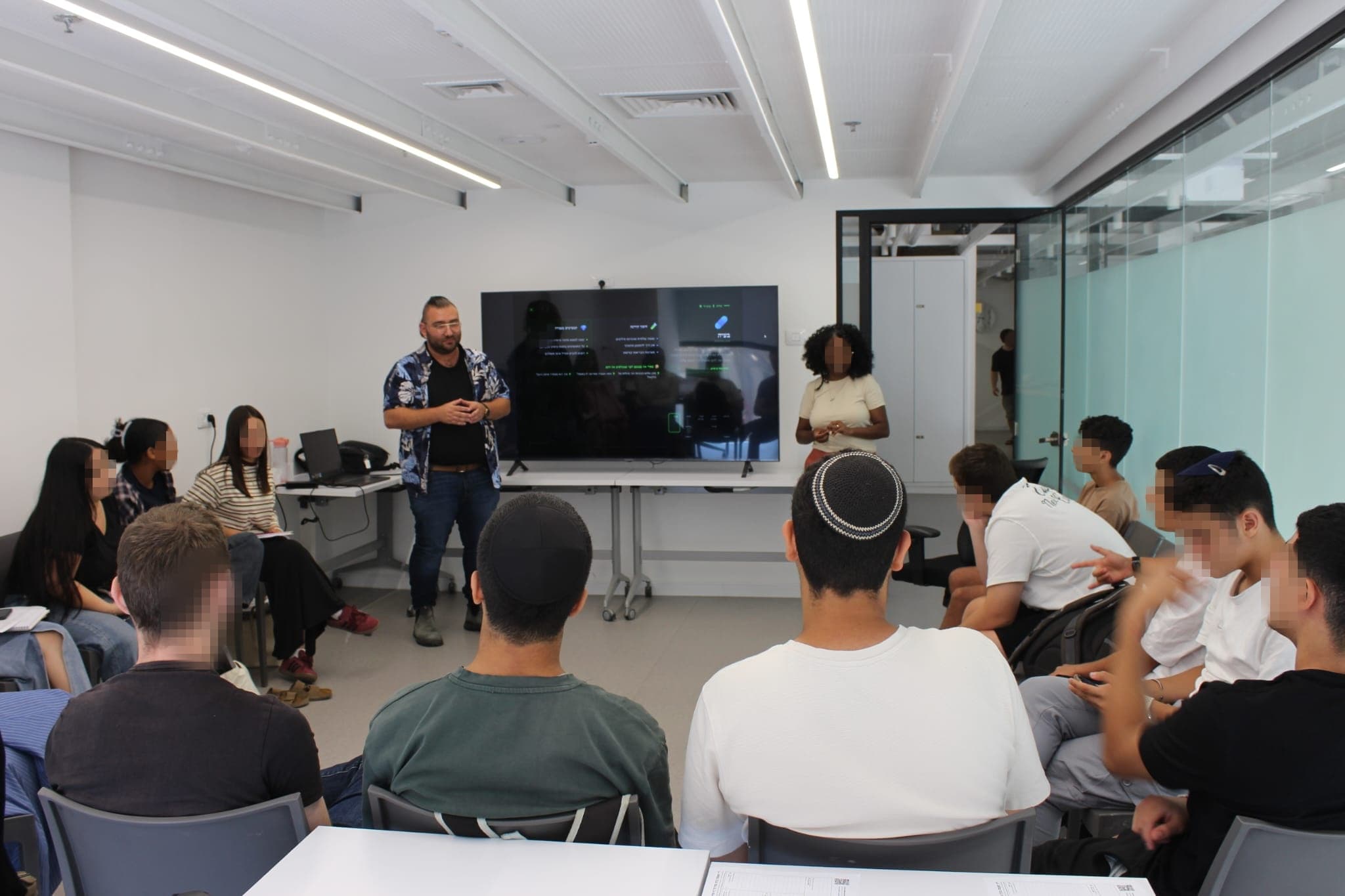
Teenovation, Meital centre Sderot
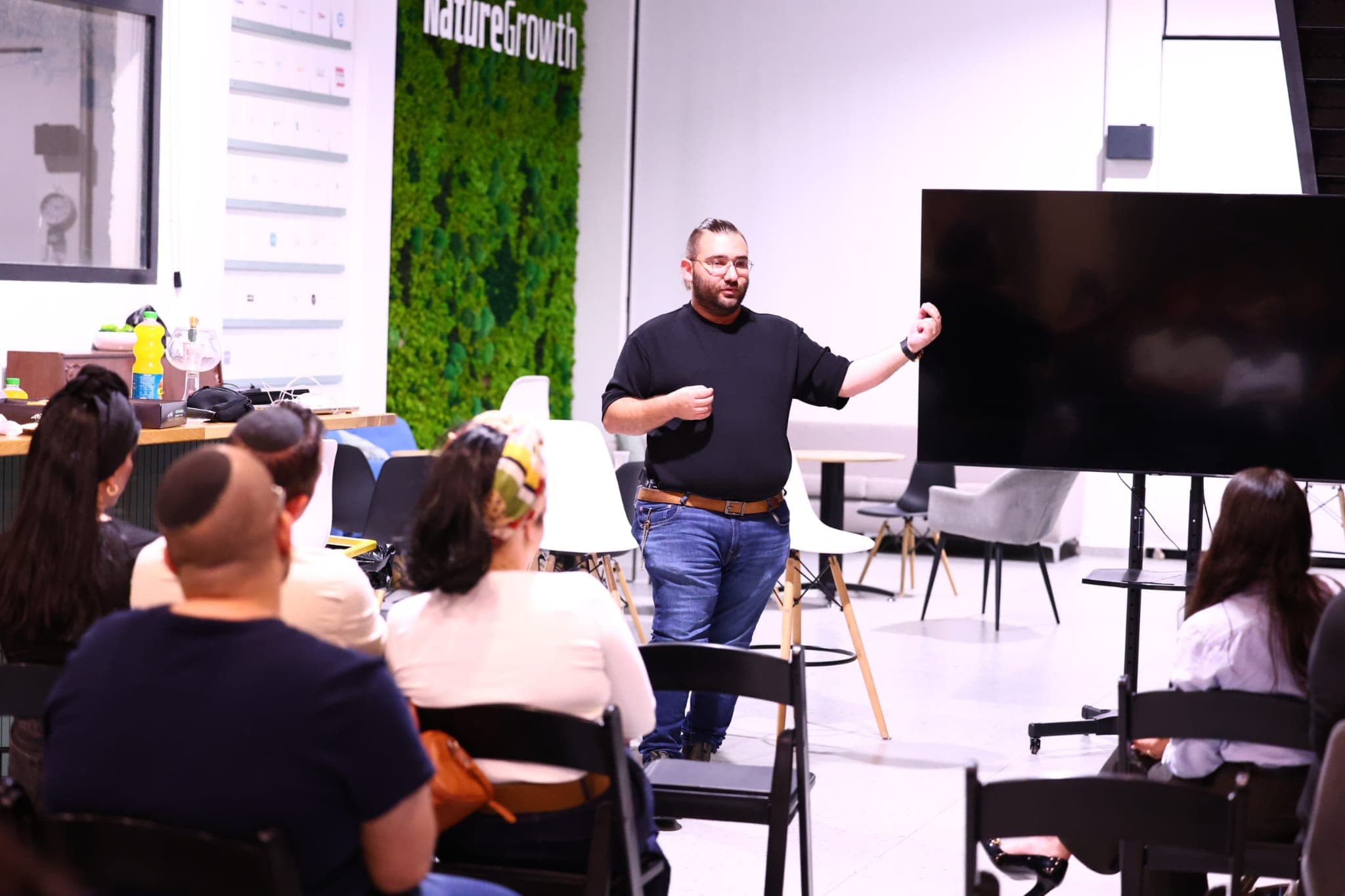
Entrepreneurs session, Sderot
I have worked with
- Google for Startups
- House of Business, Sderot Municipality
- Microsoft Reactor
- GameReady
- Eclipse Capital
- SderoTech
- IUCEL
- Resilience & Health Innovation Hub
- International Resilience Institute of Sderot


















- Google for Startups
- House of Business, Sderot Municipality
- Microsoft Reactor
- GameReady
- Eclipse Capital
- SderoTech
- IUCEL
- Resilience & Health Innovation Hub
- International Resilience Institute of Sderot
What Clients Say
From different fields, at different stages of business
Dan Manto
Eclipse Capital
Real Estate Investment and Finance, USA
Arty McLabin
GameReady
Game Development Education and Outsourcing, International

Anna
Beautician
After I finished a cosmetology course at a leading company, I was confused. I didn't know how to open a business, what to sell from home, or how to bring in clients. Since I reached out to Mobius, everything has changed. We built an organized plan with clear steps and no unnecessary risks. Today I see results, and I'm growing and developing every month.

Mark
Massage therapist, Gan Yavne
When I finished a massage course, I imagined a different world. I found out it's a hard field, and financial stability isn't easy to find. When I came to Mobius, something changed. We started an organized process and built a business plan. Without Mobius? I probably would have given up. Today I believe in myself and in my own path.
And the paperwork, for anyone who wants to see that too.

Certificate of appreciation, Sderot municipality

Certificate of honor, Teenovation 2026

Directors and officeholders course, SRI Campus
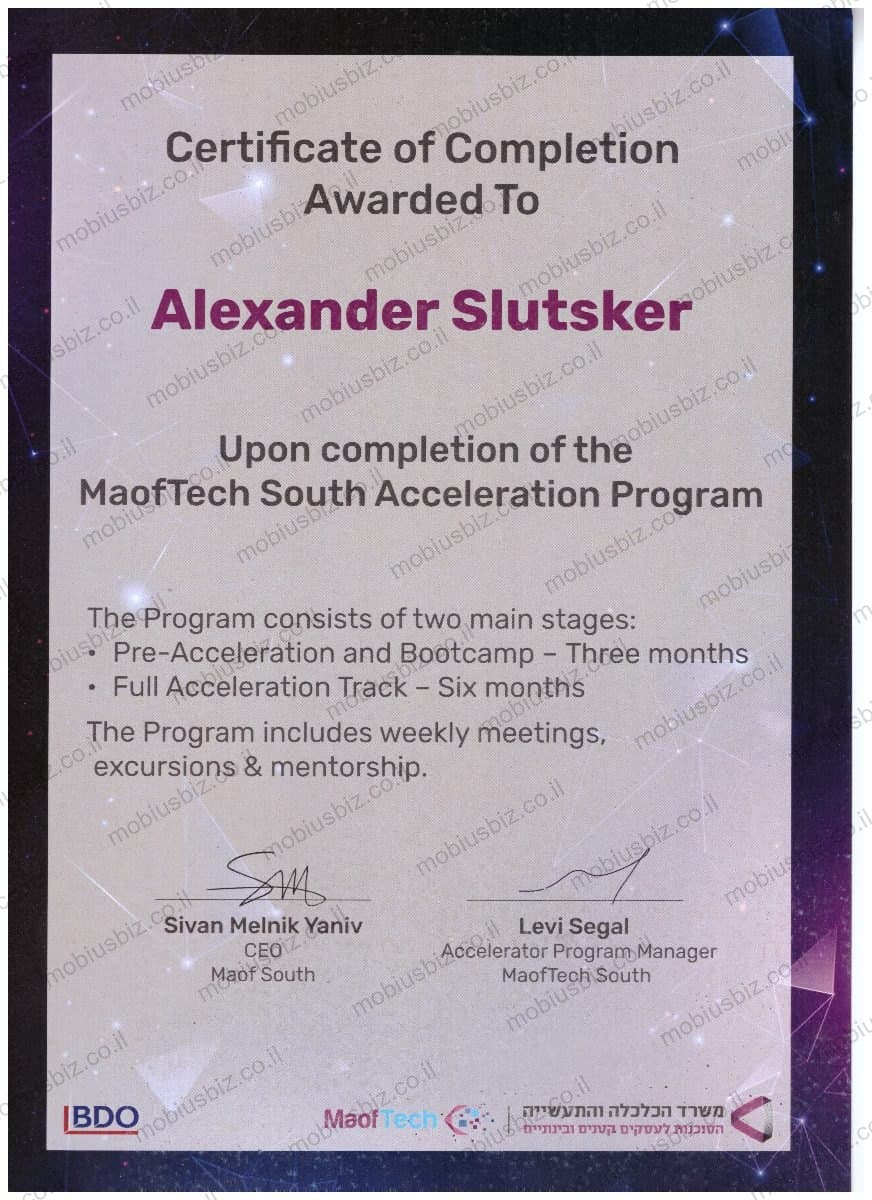
Acceleration program, MaofTech South
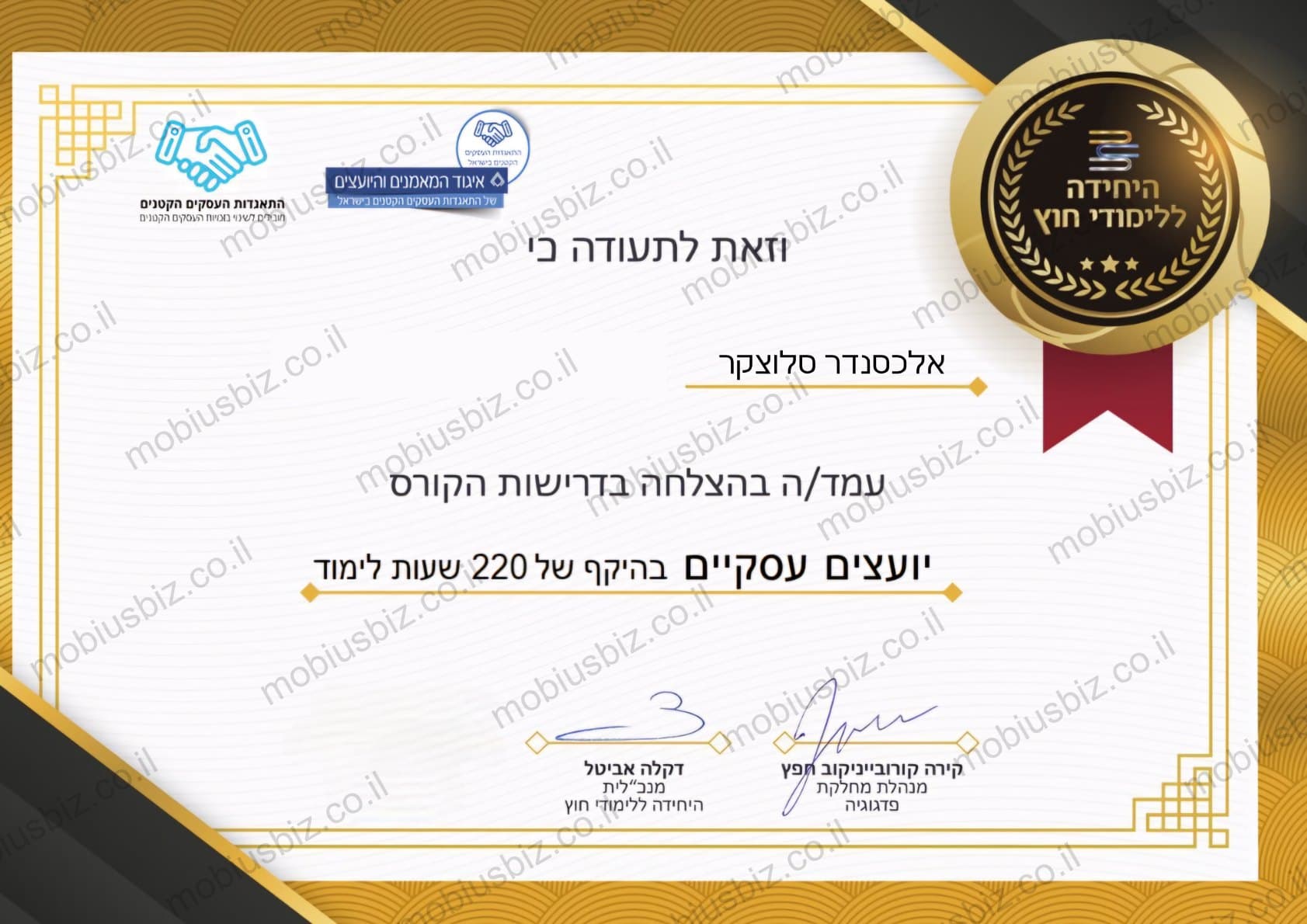
Business consultants course

Adaptive project management, INT college

Business, Marketing, Operations & Financial Consultant
Mobius
Alexander Slutsker
9+Years of experience in business consulting
I help entrepreneurs, self-employed people, small businesses and startups understand their own numbers, choose what to do first and grow from there.
Book a Free Call+972 055-248-6151. Better on WhatsApp: I am in meetings most of the day and answer as soon as I am free. Other ways to reach me
We can talk in English, Hebrew or Russian.