What Marketing Actually Is (Social Media Is a Sliver)
Marketing is understanding a market and matching a profitable offer to it. Social media is one part of the last step. Here is the real discipline, in order.
Marketing is the work of understanding a market and matching a profitable offer to it. Research, positioning, pricing, distribution, the product itself, and keeping the customers you win all come first. The posting and advertising part, the part most people picture, comes last.
Most conversations with small business owners start from the opposite end. People arrive asking for Instagram, more reels, more followers, or a new ad campaign. Those are not business problems. They are tools someone already picked, before working out what is actually stopping the business from growing.
Here is what the discipline really covers, where the money is won or lost, and the order that makes any of it pay off.
What marketing actually is
The people who defined the field never described it as promotion.
The American Marketing Association calls marketing the set of activities and processes for creating, communicating, delivering, and exchanging offerings that have value. Notice the order. Creating and delivering value come first. Communicating is one verb out of four.
Peter Drucker said a business has two functions, marketing and innovation, and that the aim of marketing is to make selling unnecessary, because the point is to understand the customer so well that the product fits them and sells itself. Philip Kotler, often called the father of modern marketing, shortened the whole thing to three words: meeting needs profitably. Theodore Levitt made the most useful version of the point in Harvard Business Review in 1960. A customer does not want a quarter-inch drill, he wants a quarter-inch hole. People buy a result, not a thing.
So marketing is not a coat of paint on a finished business. It starts with understanding the customer and reaches back into the product, the price, the packaging, and the way the thing is sold. That is also why one popular belief is so expensive: that good marketing can sell anything. It cannot. It can create interest in a weak offer for a while, but it cannot cover for the wrong price, poor service, or a product with no real demand. Sometimes strong ads only make it worse. They bring more people to a business that is not ready to serve them, and the unhappy customers and the damage to the reputation arrive faster.
Where social media actually fits
The classic map of marketing is the four Ps: Product, Price, Place, and Promotion. Product is what you sell and who it is for. Price is what you charge and why. Place is how it reaches the buyer, in a shop, online, direct, or through partners. Promotion is how you communicate it.
Social media lives inside Promotion. And Promotion is not only social. It also holds advertising, public relations, email, SEO (getting found in search), content, and direct sales. So social is one channel, inside one of four parts of the mix. That is the honest version of "just a sliver." The measured figure makes the same case: in The CMO Survey, run by Deloitte, Duke University, and the American Marketing Association, social media sat around 11 percent of marketing budgets in 2025, and the repeated forecasts that it would balloon have not come true for a decade.
Eleven percent of the budget, inside one of four Ps. The decisions that actually determine whether that spending works sit upstream, in the other three Ps and in the strategy before them.
"I need more followers" is not a marketing plan
When someone opens with "I need Instagram" or "we need more reels," they have named a tool, not a problem. Behind that request usually sits something else entirely: the offer is unclear, the business is talking to the wrong audience, the price does not match the value, the product is poorly packaged, leads come in but do not close, the business cannot serve more customers, there is no clear path from first contact to purchase, or no reason to come back.
Three mistakes show up again and again. The first is starting with the channel, deciding it must be Instagram or Google Ads or TikTok before the audience, the offer, and the goal are clear. The second is trying to sell to everyone. When the target audience is described as "men and women from 18 to 65," the business has usually not decided who its offer is really most valuable for. The third is treating a lead or a follower as the finish line. A lead is not revenue, a follower is not a customer, and even a sale is not always a profitable sale.
The earliest warning sign is a marketing conversation made entirely of content, views, followers, and lead counts, where nobody can answer the questions that matter: what does a paying customer cost, what is the margin, why do they buy, why do they refuse, do they come back, and which channel brings profitable customers rather than just leads.
The lead was never the real problem
A high cost per lead looks like an advertising problem, so the reflex is to change the creative or chase a new platform. In my experience, that reflex is usually wrong.
The expensive lead is usually a symptom. The real loss sits after the click: people who ask the price and vanish, sign up for a call or a trial and never show, or arrive curious with no intention to buy. A business in that state can pour far more money into ads and watch most of it disappear in the gap between the lead and the first real conversation, because the message that won the click never matched the offer, the follow-up was slow, or the wrong audience was being invited in the first place.
Fixing it means working the whole system, not the ad alone: how the offer is worded, what a person expects after clicking, how clear and fast the next step is, why someone agrees to a trial and then does not show, and which audiences actually intend to buy rather than browse. The cost of a lead can fall sharply once that is fixed, but the drop comes from the funnel (the path from first interest to a purchase), not the creative.
It is pointless to optimize the cost of a lead if you lose the person right after you get it. A business can double its ad budget and still watch most of it disappear inside the funnel.
If inquiries come in and too few of them become customers, tell me where they stop. Free intro call, no commitment.
What it costs to skip the strategy
Doing tactics before strategy is the most common way businesses waste money. There is no honest single average for how much, and inventing one would be the kind of made-up number to avoid. What is clear is that the losses repeat month after month, and owners usually count only the ad budget. They forget the agency fee, the video and design, the site or landing page, the CRM (a system that keeps every customer and deal in one place) and other tools, staff time, the discounts handed out to force sales, the leads nobody followed up, and the customers who were promised something the business could not deliver.
The same trap catches new channels. A business will often put a full budget into whatever is trendy, a new platform or a new ad format, because the audience is theoretically there, and come away with almost nothing to show for it. The platform is rarely the problem. The problem is assuming the audience is there and the offer is clear before spending anything to check. A channel does not earn a big budget because it is new or fashionable. First a testable idea, then a small test, then analysis, and only then scale.
The research points the same way. In a widely cited analysis of failed startups, the US firm CB Insights found the most common reason, ahead of running out of cash, was no market need. Around 42 percent of the companies had built something the market did not want. On the profit side, research by Fred Reichheld of Bain and Company found that raising retention by just 5 percent can lift profits by 25 to 95 percent, and the Harvard Business Review article that reported it adds that winning a new customer costs 5 to 25 times more than keeping one.
Put together, the expensive mistake is rarely one bad ad budget. It is spending month after month buying traffic for a system that cannot yet turn it into profit.
The order that actually works
The fix is not more effort on the same channel. It is doing the stages in the order that makes each one pay off. The process below is the one I run with a business owner, and it deliberately does not start with a channel.
- Product and customer. What the business sells, what problem it solves, who gets the most value, why they would choose this business over the alternatives, and what people are really buying, whether that is convenience, savings, status, confidence, or less risk.
- Economics. Price, margin, average order, repeat purchase, CAC (the cost to win a customer), payback, and how many new customers the business can actually serve. Sometimes scaling the current offer is not even worth it. If pricing is the weak point, how to price your services is a better first move than another ad.
- The customer journey. The whole chain, from how a stranger first hears about the business to why they would come back or refer it. Customer journey mapping is the practical tool for finding the leak.
- Only now, the channels. Social, search, SEO, partnerships, referrals, email, events, local promotion, content, and the rest. With the strategy set, a channel finally has something real to amplify, and for a small budget, digital marketing on a tight budget keeps the focus right.
This is where independent advice differs from a channel vendor. An SMM agency will recommend social. A pay-per-click agency recommends ads. A web shop recommends a new site. Starting instead from what actually limits the business changes the answer: sometimes it is ads, sometimes the price, sometimes the packaging, sometimes training the person who sells, sometimes a CRM, and sometimes it is stopping promotion entirely until the product or the operations are fixed. It is the same reason marketing fails so often. The problem is almost never the channel.
- 1Product and customer
- 2Economics
- 3Customer journey
- 4Choose channelsSpend starts here
When you should not hire a consultant
The honest answer is that plenty of the early work needs no consultant at all. Do not hire one just because you are afraid of the first step. Early on you can talk to potential customers yourself, check that the problem is real, make a simple offer, sell it by hand, put up a basic page, gather the first feedback, and test a few messages cheaply. You also do not need one if you already understand the problem and simply have to execute a clear plan.
It is the wrong move to hire when nobody has spoken to a single potential customer yet, when there is no basic description of the product, when there is no willingness to test, when the owner only wants an existing decision confirmed, when they expect a guaranteed result, or when they will not share data or act on the advice. Bringing a consultant in that early turns a quick check of the idea into long, complicated work the business does not need yet.
In Israel this matters in a specific way. Many small agencies sell one tool rather than a full diagnosis, which is not a flaw, it is their model. The trouble starts when an owner expects a single-channel specialist to fix product, price, sales, service, and management at once. The market is small, referrals and reputation carry a lot of weight, and one unhappy customer can outweigh several good ads, so spending on reach before the business can deliver is a real risk.
The right moment to bring in a consultant is when a wrong decision would be expensive, or when the owner can no longer see what is really holding the business back. That is the work I do. I hold a BBA and an MBA, I have 9+ years of experience in business consulting, and I have helped entrepreneurs, small businesses and startups open their businesses. I start every marketing question from the strategy, not the channel, so the money you spend goes where the strategy calls for it, not to tactics it has not earned. If that fits where you are, marketing consulting starts there, and you can talk it through with me before spending more. I also teach this order in my lecture on marketing on a budget, and what business owners who worked with me say is in the recommendations further down this page.
Marketing does not start with a post or an ad. It starts with understanding who you are offering what to, and why. Only then do you decide where to talk about it.
Sources
- American Marketing Association, definition of marketing (US professional body)
- Peter Drucker, Management (management theory)
- Philip Kotler, Marketing Management (marketing textbook)
- Theodore Levitt, "Marketing Myopia," Harvard Business Review, 1960 (US business journal)
- CB Insights, The Top Reasons Startups Fail (US startup analytics firm)
- Fred Reichheld, Bain and Company, via Harvard Business Review (US management research)
- The CMO Survey, Deloitte, Duke University, and the American Marketing Association, 2025 (US marketing survey)
The content on this blog is general information only and is not a recommendation to act. It is not business, legal, tax, or financial advice. Before making any decision, consult a qualified professional, such as an accountant, a lawyer, or a business advisor, about your specific situation.
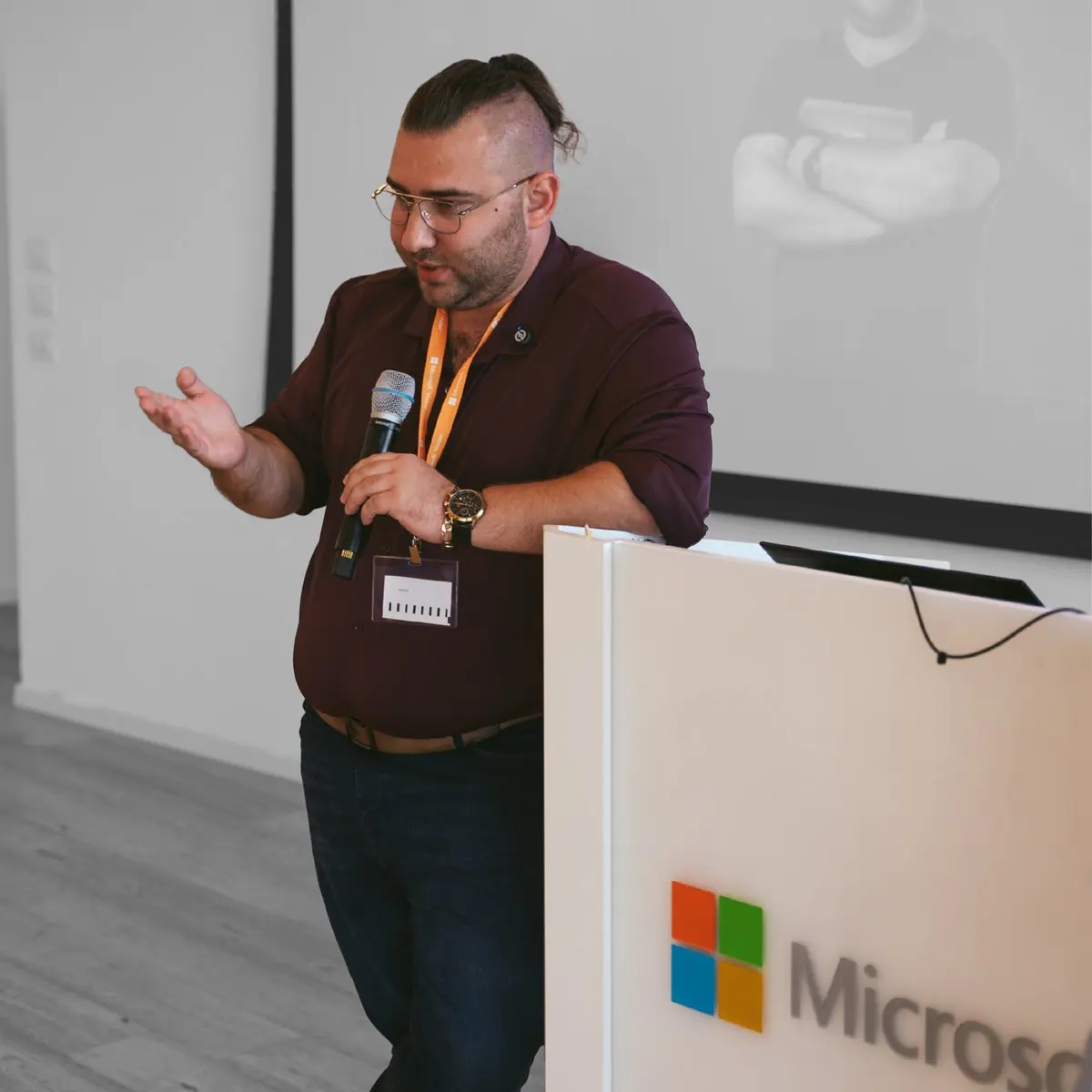
Speaking at Microsoft

Meeting with international teams, as part of work with a startup

Teenovation, Meital centre Sderot

Entrepreneurs session, Sderot
I have worked with
- Google for Startups
- House of Business, Sderot Municipality
- Microsoft Reactor
- GameReady
- Eclipse Capital
- SderoTech
- IUCEL
- Resilience & Health Innovation Hub
- International Resilience Institute of Sderot


















- Google for Startups
- House of Business, Sderot Municipality
- Microsoft Reactor
- GameReady
- Eclipse Capital
- SderoTech
- IUCEL
- Resilience & Health Innovation Hub
- International Resilience Institute of Sderot
What Clients Say
From different fields, at different stages of business
Dan Manto
Eclipse Capital
Real Estate Investment and Finance, USA
Arty McLabin
GameReady
Game Development Education and Outsourcing, International

Anna
Beautician
After I finished a cosmetology course at a leading company, I was confused. I didn't know how to open a business, what to sell from home, or how to bring in clients. Since I reached out to Mobius, everything has changed. We built an organized plan with clear steps and no unnecessary risks. Today I see results, and I'm growing and developing every month.

Mark
Massage therapist, Gan Yavne
When I finished a massage course, I imagined a different world. I found out it's a hard field, and financial stability isn't easy to find. When I came to Mobius, something changed. We started an organized process and built a business plan. Without Mobius? I probably would have given up. Today I believe in myself and in my own path.
And the paperwork, for anyone who wants to see that too.

Certificate of appreciation, Sderot municipality

Certificate of honor, Teenovation 2026

Directors and officeholders course, SRI Campus
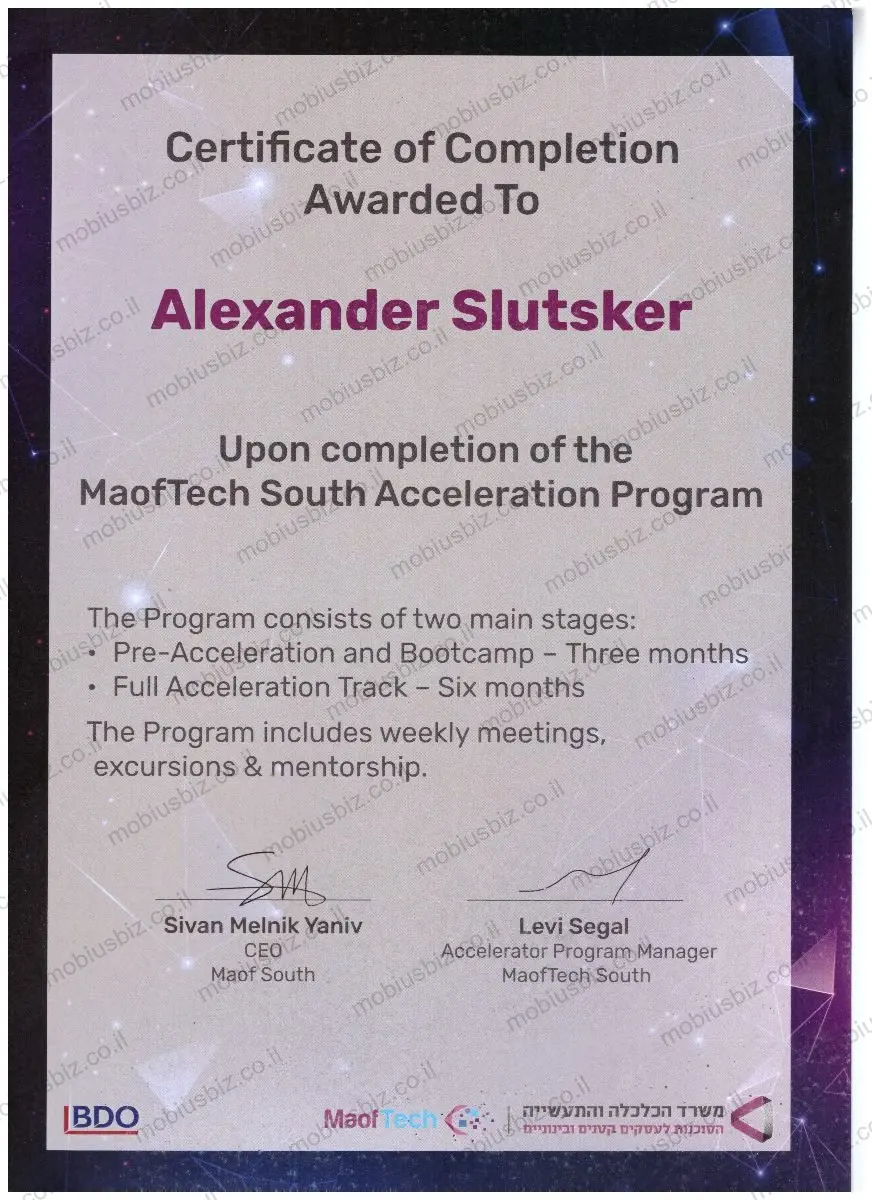
Acceleration program, MaofTech South

Business consultants course

Adaptive project management, INT college

Business, Marketing, Operations & Financial Consultant
Mobius
Alexander Slutsker
9+Years of experience in business consulting
I help entrepreneurs, self-employed people, small businesses and startups understand their own numbers, choose what to do first and grow from there.
Book a Free Call+972 055-248-6151. Better on WhatsApp: I am in meetings most of the day and answer as soon as I am free. Other ways to reach me
We can talk in English, Hebrew or Russian.