Business Coach or Business Consultant: Which Do You Need?
A business coach helps you find your own answers. A business consultant brings knowledge of how a business works. How to tell which one your business needs.
Break-even Calculator
See how many units you need to sell before the business starts covering its fixed costs.
Break-even units
167
Break-even revenue
₪33,400
Contribution margin per unit
₪120
Contribution margin percent
60%
What this means
You need 167 units, or ₪33,400 in sales, to cover fixed costs. Each unit contributes ₪120, a contribution margin of 60%.
Want to pressure-test the business model behind the numbers?
Book a free call+972 055-248-6151. Other ways to reach me
This is a simplified, illustrative tool meant to give you a quick feel for the numbers. It is not professional advice. Real business decisions depend on many factors it does not account for, and all results are estimates only. Mobius Business Solutions accepts no responsibility for decisions or actions taken based on this tool.
Business coach or business consultant? A business coach helps you reach your own answers about how you work, decide and act. A business consultant brings knowledge of how a business works, finds what is actually stuck, and proposes what to do about it. When the problem sits in the business mechanics, its customers, prices, costs and market, you need a consultant. I am Alex Slutsker, a business consultant at Mobius Business Solutions, and this is how I tell the two apart.
In practice the two words blur, and many providers use both for the same service. So the useful question is not which title sounds better. It is where your business is actually stuck.
What is the difference between a business coach and a business consultant?
A business coach is an expert in the coaching process. The coach treats you as the expert on your own business and guides you, with questions, toward answers you own. A business consultant brings the subject knowledge, finance, marketing, operations and strategy, diagnoses what is happening, explains why and proposes what to do. Either way, the decisions stay yours.
That is also how the coaching profession draws the line itself: in coaching, you are the subject matter expert. In consulting, someone else is.
In a meeting, the difference looks like this:
- Who holds the answer. With a coach, you do, and the coach guides the process. With a consultant, the consultant brings knowledge and a proposal.
- What you hear. A coach asks questions that help you find your own direction. A consultant gives you a diagnosis, the reasoning behind it and a proposed next step.
- What it is built for. Coaching is built for how you set goals, decide and follow through. Consulting is built for what the business does: customers, prices, costs, market and process.
- What you leave with. From coaching, your own insight and your own commitments. From consulting, a named problem, the cause behind it and what to do first.
Do I need a coach or a consultant?
It depends where you are stuck. If you know what the business should do, the numbers support it and the gap is in acting on it, coaching is built for that. If you work harder and the numbers do not move, customers do not come or the money disappears, the problem is in the business, which is consulting work.
Signs the problem sits in the business mechanics:
- You work more hours every month and the numbers stay where they were.
- The product is good, and customers still do not come, or do not come back.
- Money comes in and nothing is left at the end of the month.
- A decision is waiting, a hire, a price change, a loan, and you cannot say what it would do to your numbers.
- Everything goes through you, and the business stops when you stop. That is usually a bottleneck (the step that slows everything else), and a bottleneck can be found.
Coaching fits when the business itself is sound and what you want to work on is you as the person running it: how you set goals, how you decide and how you follow through.
Sometimes neither one is the right first call. If a debt is due this month, a financial professional comes first. If the pressure has become more than a business problem, talk to someone qualified to help with that.
Why does a business problem feel like a personal one?
Because the market answers your actions late, and without explanation. When customers do not come, it is easy to read the silence as a verdict on yourself. More often the owner has simply never been shown how the business mechanics work: who buys first, why they buy, and how long the market takes to respond to something new.
Here is how I put it:
"People read their low moments as proof that they are not good enough. Usually they just do not yet understand the mechanics of the real business world. Once you understand how the pieces work, you can tell whether you are doing the right things or the wrong ones. The world responds to our actions, but not always instantly."
Take a new hair salon that opens in a neighbourhood. The people who live there do not trust it yet, so they do not walk in just because it opened. Nothing is wrong with the haircuts. The salon has met a pattern that was described long ago.
Everett Rogers set it out in his book Diffusion of Innovations, first published in 1962. In his definition an innovation is any idea, practice or object that people perceive as new, not only a new technology. So a new salon on the street is an innovation to the people who live on it. Adoption then moves through groups in order: innovators, early adopters (the first people willing to try something new), the early majority, the late majority, and finally the laggards. Plotted over time, adoption follows an S curve: slow at first, then faster, then levelling off.
"Innovation is not only new technology. There are many methods and theories that have already shown how these elements work, the early adopters, the sceptics and the rest. With them you can explain, statistically too, what is going on in a specific business process."
That is why one of the first jobs is to find your key customers. In business language that is your ICP (ideal customer profile, a short description of the customer who gets the most value from you). An owner who reads a slow start as a personal failure tends to push harder at everyone at once. An owner who knows the curve looks for the people most likely to try first and earns their trust.
What happens when confidence grows but the knowledge does not?
You push harder in the same direction. If the direction is wrong, more energy means more hours spent and more money lost, only now with conviction. Confidence helps you act. It does not tell you which action is right, and in business the market responds to the action, not to how sure you felt taking it.
"Feeling stronger without understanding what to do only makes you more ambitious. You work harder, and you lose more, with confidence. That is a problem in the business mechanics, and it takes a deep understanding of the situation to solve it."
Research on small businesses supports the knowledge half of this, with one condition attached. A randomised trial with women running very small businesses in Kenya compared two kinds of help: a mentor, an experienced entrepreneur from the same community, and a formal business class. Mentorship raised profits by 20 percent on average, and the effect faded as the mentoring relationships ended. The class changed business practices but had no effect on profits. The authors' reading was that the local, specific knowledge of mentors increased profit, while abstract, general information did not (Brooks, Donovan and Johnson, American Economic Journal: Applied Economics, 2018).
It is one study, in a very different market, and it promises nothing about any particular business. What it shows is the condition: knowledge counts when it is specific to your business and gets put to use.
Knowledge matters more than extra confidence without the right background.
Why I have hired business coaches myself
I have hired several business coaches, from different backgrounds, to experience the service, the approach and the methods first hand. The first ones I hired before I became a business consultant, before I had even thought about becoming one. I was a young entrepreneur running a few business projects of my own, and those projects had a problem with the business mechanics, not with my confidence in myself or in my actions.
So when I write about the difference, I write as someone who has sat on both sides of the table, first as the client and now as the consultant.
What should a good business consultant sound like?
Simple. A good business consultant explains the business mechanics in plain words, turns them into simple actions and gives the reasoning behind each one. If a consultant sounds too hard or speaks a language you do not understand, that is not proof the business is beyond you. It is a sign you are with the wrong consultant.
"A good business consultant can explain the business mechanics in simple words, with simple actions and the reasoning behind them, so that the next time you are in the same situation you know how to think it through. Not by a rule of thumb, but because you understand what is right in that specific case, and why."
The order of the work tells you a lot too. With me it runs like this:
- First I make sure I understand what the problem is.
- Then I tell you whether I can help, and how.
- Only after that comes a proposal.
If you have already decided that a consultant is what you need, the next step is choosing one, and how to choose a business consultant covers the questions to ask and the red flags. How the ongoing work is structured with me is on the page for strategic and ongoing business consulting.
How do I test the decision I am stuck on?
Put that one decision through your own numbers. Pick the step you keep postponing: a hire, a new fixed cost, a price change. Enter your fixed costs, price and variable cost per sale in the break-even calculator above, then add the monthly cost of that step to the fixed costs and see how many more sales the business needs.
This is the business mechanics made visible. Your break-even point (where income covers all costs) moves, and you can see exactly by how much. The calculator will not make the decision for you, and it will not tell you how to feel about it. It puts the decision on numbers instead of on a guess.
Where to start if you are still not sure
Write down the one thing that is stuck, in a single sentence. If the sentence is about you, how you decide and follow through, coaching is built for that. If it is about the business, its customers, prices, costs or process, start with a diagnosis of the business.
If you want to know who I am before we talk, read who is Alex Slutsker. If you want to put your own sentence in front of someone, talk it through with me. The first conversation is free, and in it we name the problem before anything else.
Sources
- Wyatt Brooks, Kevin Donovan and Terence R. Johnson, "Mentors or Teachers? Microenterprise Training in Kenya", American Economic Journal: Applied Economics 10(4), 2018
- Everett M. Rogers, Diffusion of Innovations, first published 1962
The content on this blog is general information only and is not a recommendation to act. It is not business, legal, tax, or financial advice. Before making any decision, consult a qualified professional, such as an accountant, a lawyer, or a business advisor, about your specific situation.
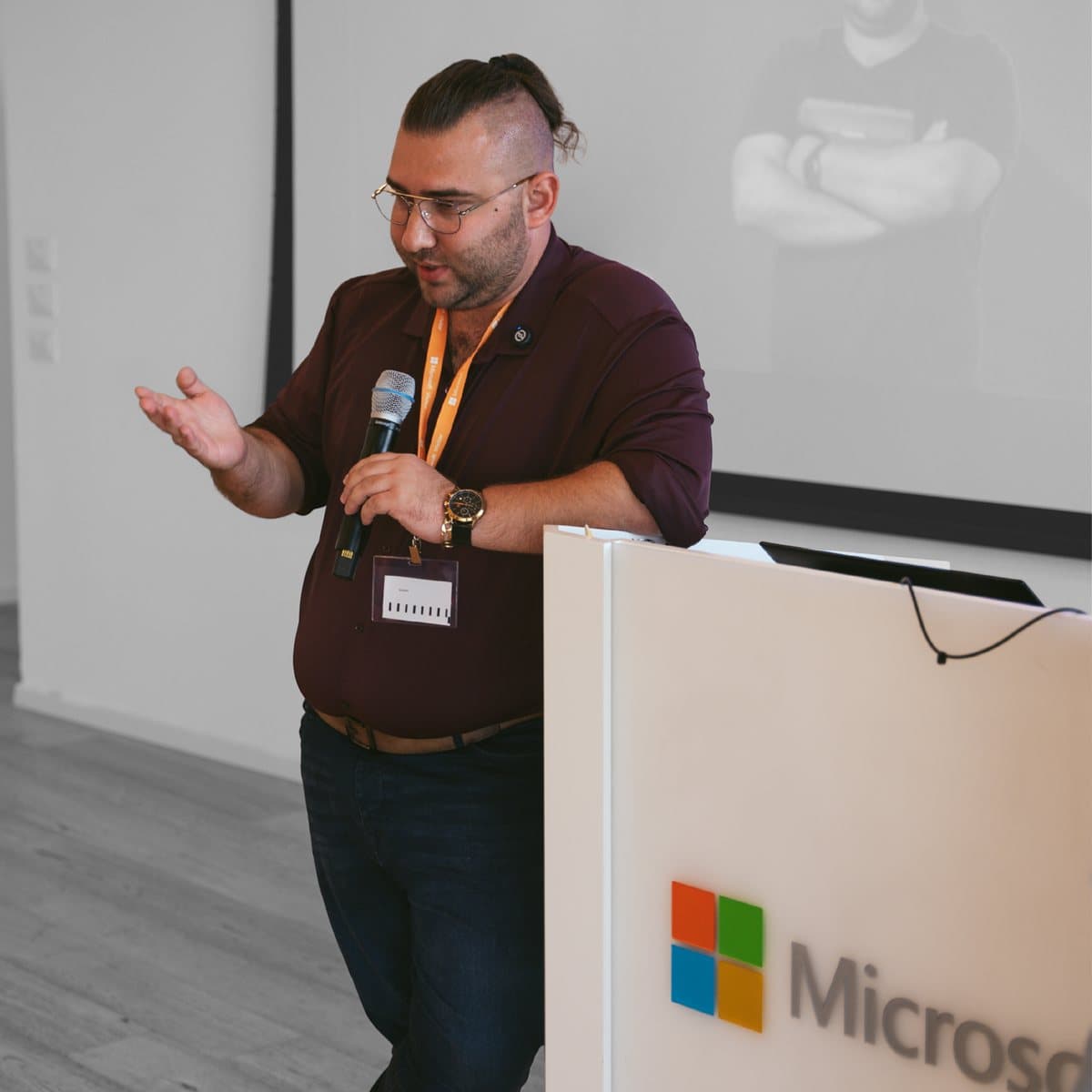
Speaking at Microsoft

Meeting with international teams, as part of work with a startup
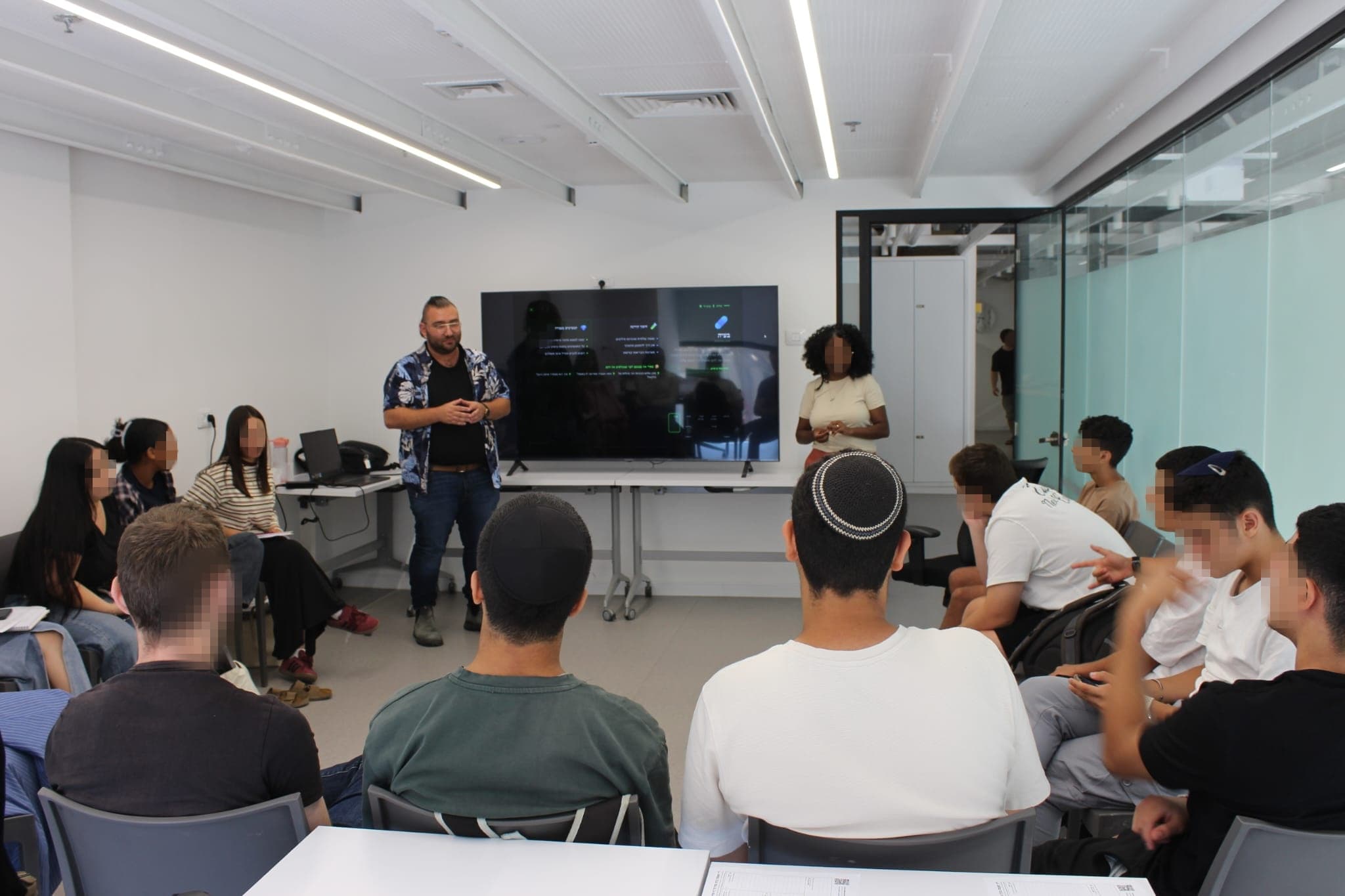
Teenovation, Meital centre Sderot
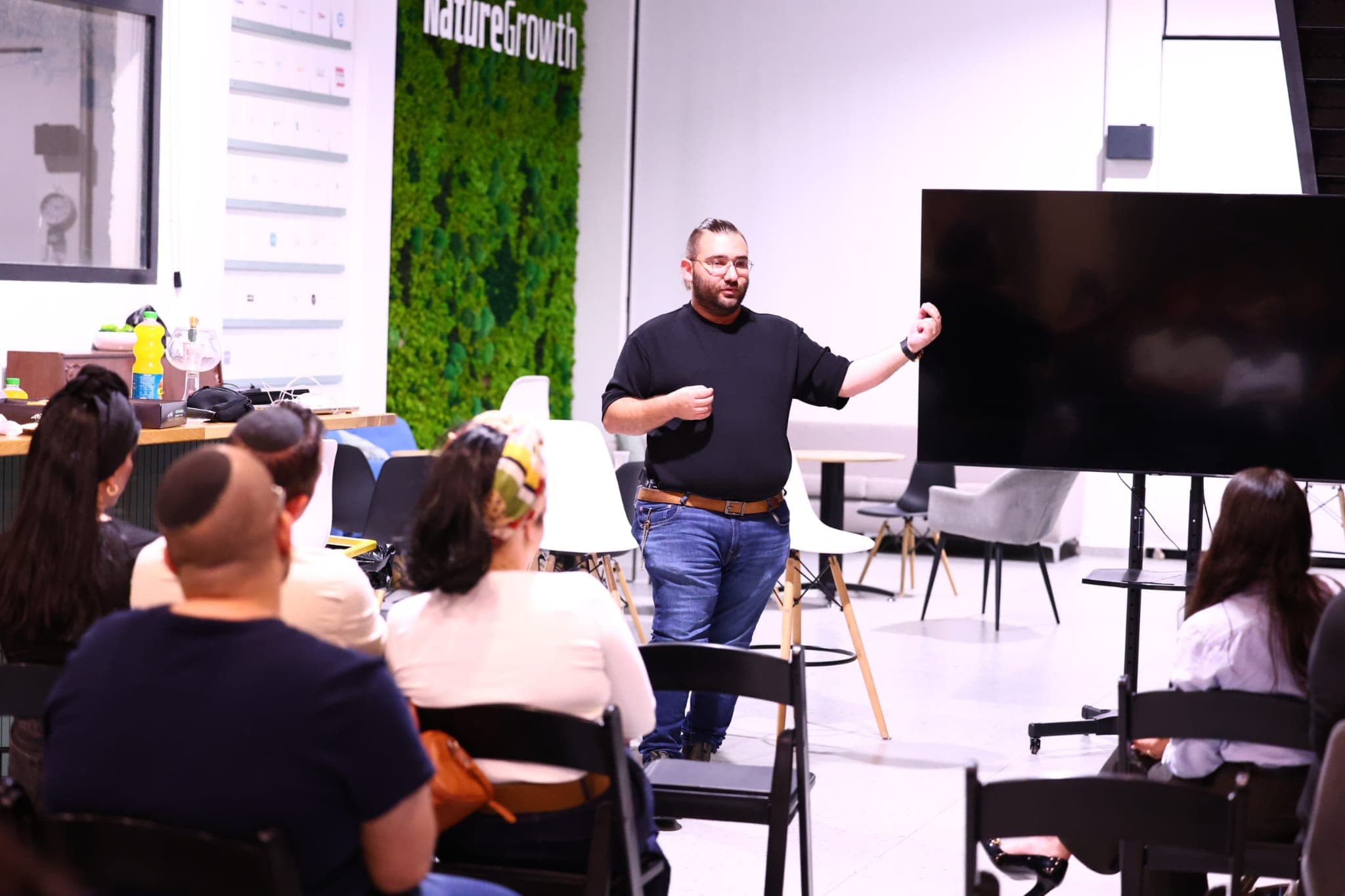
Entrepreneurs session, Sderot
I have worked with
- Google for Startups
- House of Business, Sderot Municipality
- Microsoft Reactor
- GameReady
- Eclipse Capital
- SderoTech
- IUCEL
- Resilience & Health Innovation Hub
- International Resilience Institute of Sderot
















- Google for Startups
- House of Business, Sderot Municipality
- Microsoft Reactor
- GameReady
- Eclipse Capital
- SderoTech
- IUCEL
- Resilience & Health Innovation Hub
- International Resilience Institute of Sderot
What Clients Say
From different fields, at different stages of business
Dan Manto
Eclipse Capital
Real Estate Investment and Finance, USA
Arty McLabin
GameReady
Game Development Education and Outsourcing, International

Anna
Beautician
After I finished a cosmetology course at a leading company, I was confused. I didn't know how to open a business, what to sell from home, or how to bring in clients. Since I reached out to Mobius, everything has changed. We built an organized plan with clear steps and no unnecessary risks. Today I see results, and I'm growing and developing every month.

Mark
Massage therapist, Gan Yavne
When I finished a massage course, I imagined a different world. I found out it's a hard field, and financial stability isn't easy to find. When I came to Mobius, something changed. We started an organized process and built a business plan. Without Mobius? I probably would have given up. Today I believe in myself and in my own path.
And the paperwork, for anyone who wants to see that too.

Certificate of appreciation, Sderot municipality

Certificate of honor, Teenovation 2026

Directors and officeholders course, SRI Campus
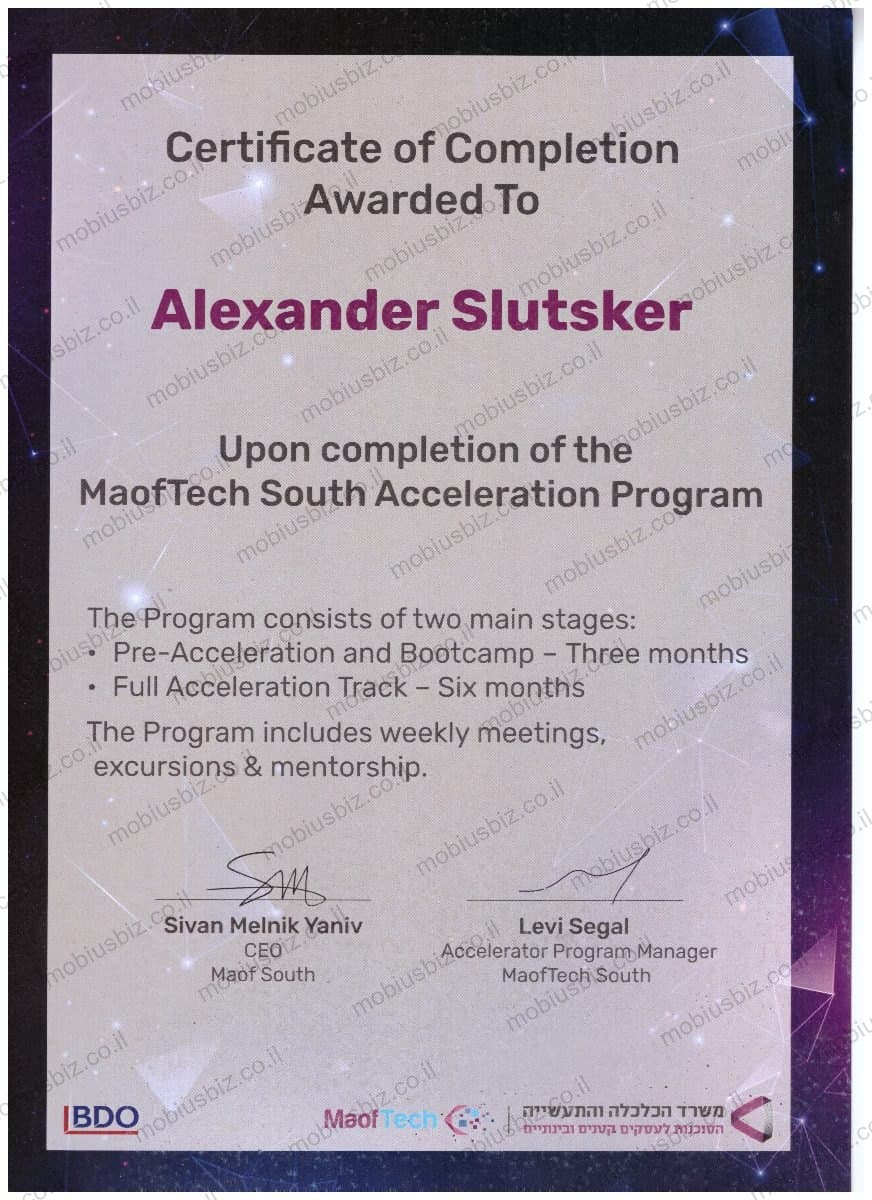
Acceleration program, MaofTech South
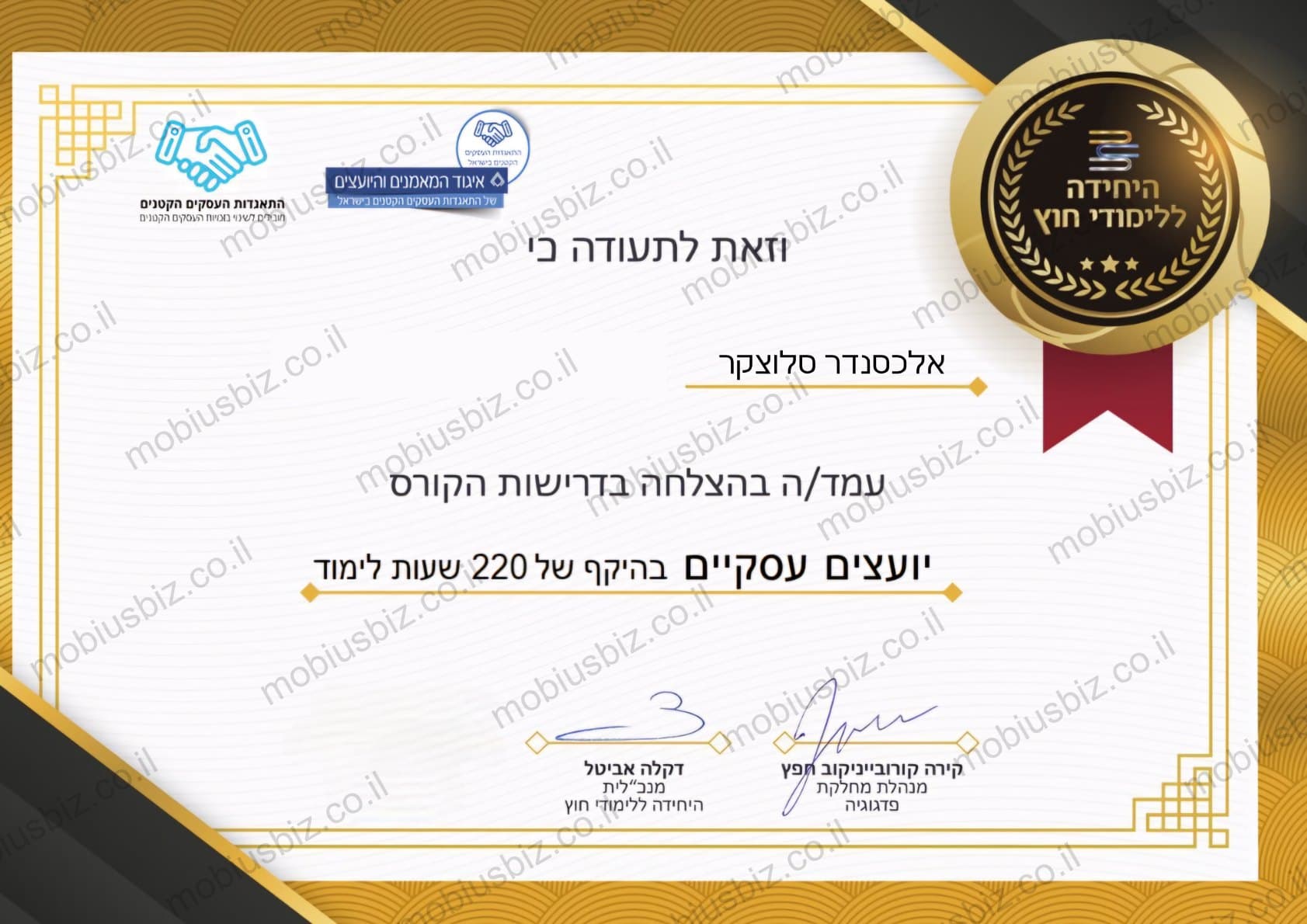
Business consultants course

Adaptive project management, INT college
Frequently asked questions
Do I need a business coach or a consultant before I open my business?
Can a consultant help me check my idea before I spend money on it?
What should I bring to a first conversation with a consultant?
Will a new business get customers faster if I am more confident?
I work nonstop and the business is not growing. Where do I look first?
Is a business coach worth it for a small business?
Can one person be both my coach and my consultant?
What should I ask about price before I hire either one?
Does needing outside help mean I am not good enough to run a business?
What does "business mechanics" actually mean?
What if I hire the wrong kind of help?
Will a business consultant just tell me what to do?
Terms from the business glossary
More Articles

Business, Marketing, Operations & Financial Consultant
Mobius
Alexander Slutsker
9+Years of experience in business consulting
I help entrepreneurs, self-employed people, small businesses and startups understand their own numbers, choose what to do first and grow from there.
Book a Call+972 055-248-6151. Better on WhatsApp: I am in meetings most of the day and answer as soon as I am free. Other ways to reach me