What AI and Data Actually Do for a Business (Not Magic)
AI and data pay off where the goal is clear and the data is clean, and waste money everywhere else. Here is what they really do for a small business.
What is AI
AI (artificial intelligence) is software that does tasks that used to need a person, such as writing, sorting or predicting, by learning patterns from data.
Illustration
Which circle does each task sit in?
Two of the bakery’s four tasks are AI, and they sit in different circles. Tap a task to light the ring that does it.
AI (artificial intelligence) and data are not magic, and treating them as magic is the fastest way to waste money on both. What they actually do is narrow and useful: data is the information your business already generates, and AI is a set of tools that can find patterns in it or draft text and predictions from it. Used on a clear task with clean information, they save real time and sharpen real decisions. Pointed at a vague goal or messy data, they produce confident nonsense at a monthly cost.
Most of the disappointment around AI comes from skipping the two things that make it work: a specific job to do, and clean data to do it on. Once you see what AI and data actually do, the pressure to adopt something turns into a calm decision about where they pay off.
What AI and data actually do
Data is your raw material: sales, customers, what sells and when, the record of how the business actually behaves. AI is a set of tools that either generate things from patterns (drafts, summaries, replies) or find patterns in your data (trends, predictions, groupings). Neither is a strategy. They are inputs to better work and better decisions.
It helps to keep them apart, because much of what people call an AI win is really just finally looking, cleanly, at data they already had. You can get real gains from organized data and simple analysis long before you need anything advanced. And you can get real gains from ready made AI tools without any data of your own. Knowing which one a task needs saves a lot of wasted effort.
Where AI actually pays off today
The reliable wins are practical and specific: drafting content, answering routine questions, summarizing and rewriting text, and cutting repetitive admin. They share a shape: the task is well defined, it repeats, and a mistake is cheap to catch. That is where today's AI is strong, as a fast assistant on clear, repetitive work, with a person checking the output.
Where it struggles is the mirror image: vague goals, unsupervised decisions, and anything where being confidently wrong is expensive. AI does not know when it is wrong. It can state something false with the same confidence as a fact, which is called a hallucination. So the safe starting point is a narrow task with an obvious payoff and easy review, not handing it your judgment and leaving it unchecked.
Clean data comes before clever tools
Most of the value people chase with AI actually lives in a duller place: getting their data clean and in one place, one spreadsheet or one database instead of five. Clean data (accurate, consistent, organized) is what any analysis or AI depends on. Feed a clever tool messy, scattered, duplicated data and it will give you confident, useless answers.
This is why analytics and prediction come later, not first: they need clean history and a baseline most small businesses do not have yet. You can use generative AI, the tools that write and summarize, today with no data of your own. But the moment you want insight from your own numbers, the real first step is the boring one: getting the data organized. Do that, and simple analysis often delivers more than any AI bolted on top of a mess.
Where it goes wrong: no clear goal, too much at once
When an AI project goes nowhere, the cause is rarely the technology. Usually it is one of two plain things. The first is no clear goal: adopting AI because it is exciting rather than to solve a specific, measurable problem, so there is no way to tell whether it helped. The second is trying to do too much at once, a sprawling initiative instead of one narrow task with a clear before and after.
The fix is discipline, not ambition. Pick one task where you can measure the change, use AI there, and check the result. A small, focused use that clearly saves a few hours a week beats a grand project that impresses in a meeting and delivers nothing you can point to. And beware of tool overload: a pile of overlapping AI subscriptions, each doing a little, is a reliable way to spend money with no clear return.
What it costs to chase AI instead of aiming it
Chasing AI rarely looks like a mistake. It looks like keeping up. It shows up as subscriptions bought on excitement and barely used, an unsupervised tool making confident errors with customers, dashboards built on data nobody trusts and nobody acts on, and hours lost trying shiny tools instead of doing the work.
None of this feels like an AI decision gone wrong. It feels like you just need the next model or the next tool. But it traces back to the same gap: adopting the technology before naming the task and cleaning the data. The cost is not only the wasted subscriptions. It is the mistakes made on messy data, and the attention spent chasing hype instead of aiming one tool at a real problem.
The order that actually works
- Name one task. Pick a specific, repetitive job with a clear before and after: drafting, routine replies, admin.
- Check the risk. Choose tasks where a mistake is cheap to catch, and keep a person reviewing anything customer facing.
- Clean the data first, if the task needs your own numbers. Organized, in one place, before any analysis.
- Use ready made tools for now. You rarely need to build anything. Existing AI handles most practical tasks.
- Measure the change. Time saved and mistakes prevented on the one task, not a vague sense of being modern.
- Expand only where it paid off. Add the next narrow use once the last one has proved itself. Keep the toolset small.
Owners often start by adopting AI broadly and hoping value appears. Follow this order and every use is a clear task that saves time. Skip it and what piles up is cost and confident nonsense.
Picking the first narrow task for AI and fitting it into how the work already runs is part of operations consulting.
When you should not hire a consultant
If you use AI on specific tasks that clearly save time, your data is clean and in one place, and you buy tools from a real need rather than fear of missing out, your AI and data choices are sound and you do not need help.
An outside view earns its place when you want to use AI but cannot name the task, when your data is so scattered that nothing built on it can be trusted, or when you cannot tell hype from value in what you are being sold. There, the help is not more AI. It is the discipline to pick one narrow, valuable use, clean the data first, and skip the exciting thing that does nothing. As a business consultant, I would rather help you aim one tool at a real problem than watch you pay for a stack that impresses and delivers nothing. If that is where you are, talk it through with me.
The content on this blog is general information only and is not a recommendation to act. It is not business, legal, tax, or financial advice. Before making any decision, consult a qualified professional, such as an accountant, a lawyer, or a business advisor, about your specific situation.

Speaking at Microsoft

Meeting with international teams, as part of work with a startup
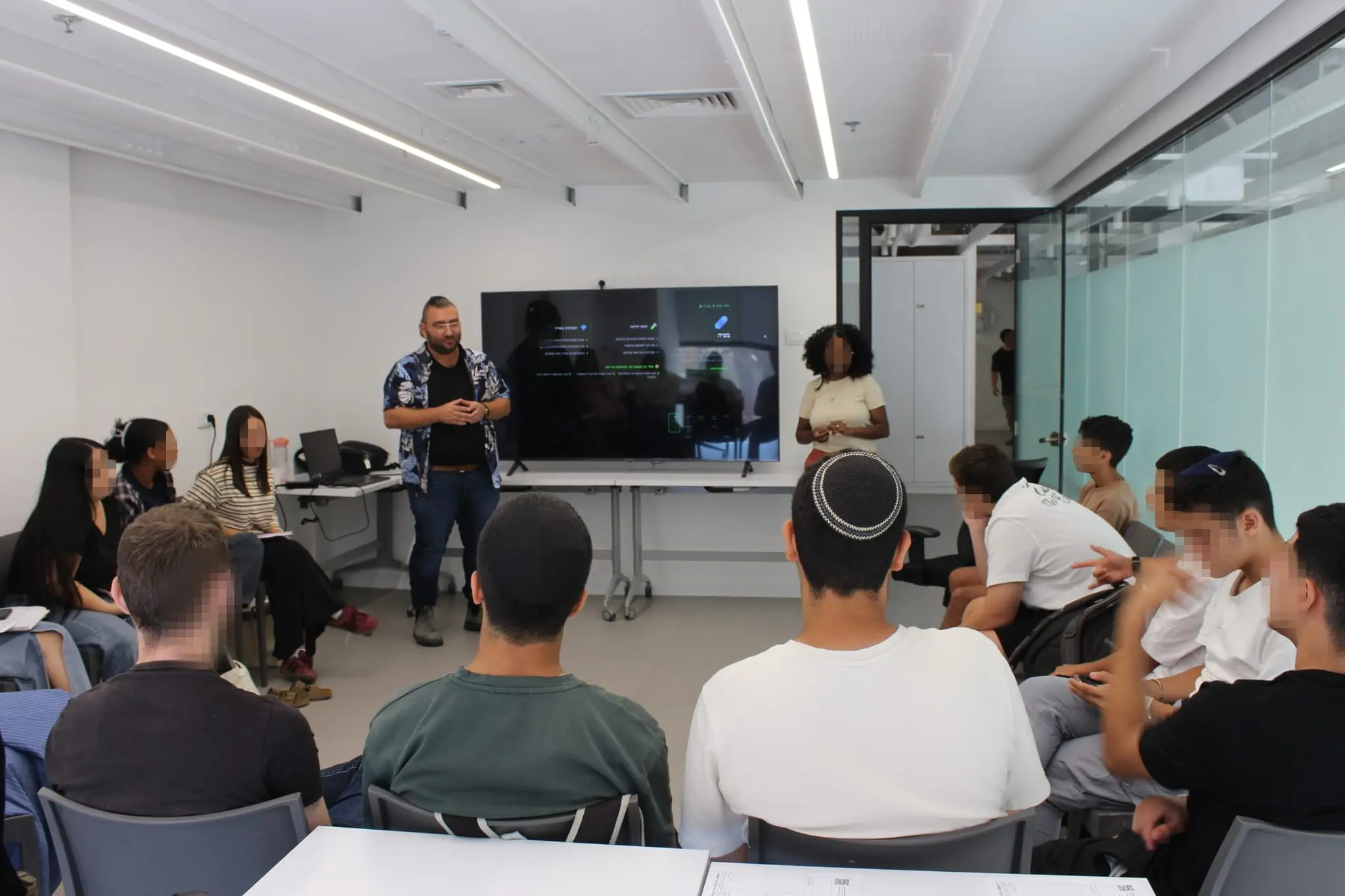
Teenovation, Meital centre Sderot

Entrepreneurs session, Sderot
I have worked with
- Google for Startups
- House of Business, Sderot Municipality
- Microsoft Reactor
- GameReady
- Eclipse Capital
- SderoTech
- IUCEL
- Resilience & Health Innovation Hub
- International Resilience Institute of Sderot


















- Google for Startups
- House of Business, Sderot Municipality
- Microsoft Reactor
- GameReady
- Eclipse Capital
- SderoTech
- IUCEL
- Resilience & Health Innovation Hub
- International Resilience Institute of Sderot
What Clients Say
From different fields, at different stages of business
Dan Manto
Eclipse Capital
Real Estate Investment and Finance, USA
Arty McLabin
GameReady
Game Development Education and Outsourcing, International

Anna
Beautician
After I finished a cosmetology course at a leading company, I was confused. I didn't know how to open a business, what to sell from home, or how to bring in clients. Since I reached out to Mobius, everything has changed. We built an organized plan with clear steps and no unnecessary risks. Today I see results, and I'm growing and developing every month.

Mark
Massage therapist, Gan Yavne
When I finished a massage course, I imagined a different world. I found out it's a hard field, and financial stability isn't easy to find. When I came to Mobius, something changed. We started an organized process and built a business plan. Without Mobius? I probably would have given up. Today I believe in myself and in my own path.
And the paperwork, for anyone who wants to see that too.

Certificate of appreciation, Sderot municipality

Certificate of honor, Teenovation 2026

Directors and officeholders course, SRI Campus
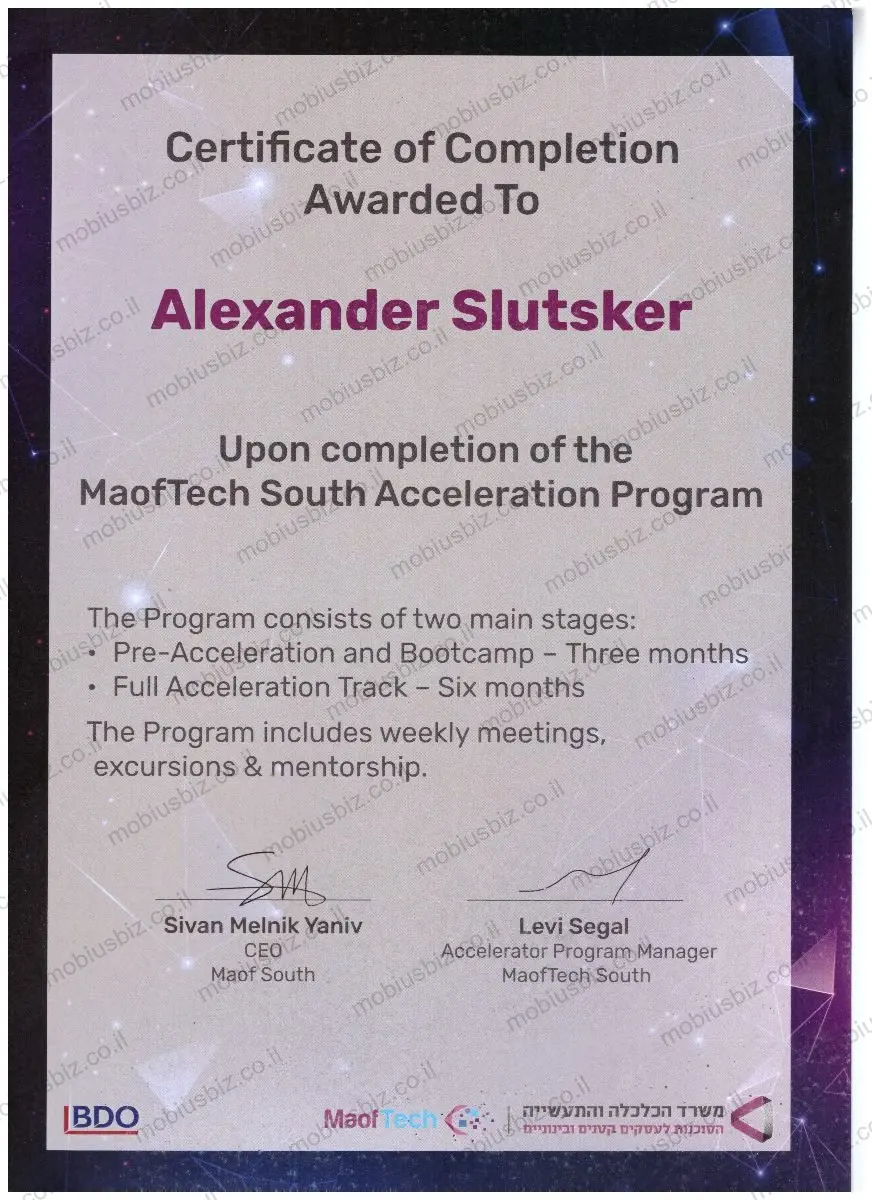
Acceleration program, MaofTech South

Business consultants course

Adaptive project management, INT college

Business, Marketing, Operations & Financial Consultant
Mobius
Alexander Slutsker
9+Years of experience in business consulting
I help entrepreneurs, self-employed people, small businesses and startups understand their own numbers, choose what to do first and grow from there.
Book a Free Call+972 055-248-6151. Better on WhatsApp: I am in meetings most of the day and answer as soon as I am free. Other ways to reach me
We can talk in English, Hebrew or Russian.