Remote across Israel
Business consulting for entrepreneurs, small businesses and startups.
You had no one to ask. Now you do.
Most of what you learn in business, you learn from experience, and sometimes from expensive mistakes. It is a shame to pay for them on your own when they could have been avoided.
Intro call, 15 to 30 minutes, free
No obligation. We just talk.
The message comes straight to me, and I'm the one who answers it.
+972 055-248-6151. Better on WhatsApp: I am in meetings most of the day and answer as soon as I am free. Other ways to reach me

Alexander Slutsker
- Two degrees in business administration, specializing in finance, marketing, entrepreneurship and hi-tech consultingWho I am and how I work
- A consultant for entrepreneurs who talks straightSee me for a minute before you write
- 9+ years of experience in business consultingTell me about your business on WhatsApp


Which stage your business is in
Four stages in the life of a business. Find yours. Underneath it are the sentences you may recognize as your own, and then how we work on it together if that is where you are.
Nobody teaches you how to open a business, so most people learn on the way and at their own expense. The common mistake is leaving the job and putting the savings in before there is a plan, and the risk there is double. On one side the money goes into equipment, stock or advertising without knowing whether this is the right move at the right moment, or whether it will ever pay itself back. On the other the salary stops exactly when the business still does not cover the household. There is another way. Plenty of businesses are opened alongside a job and tested small before anyone gives up a steady income. Planning before the first move lowers both of those risks at once.
A profession means knowing how to do the work. A business means knowing who to sell it to, at what price, and how to bring the next client without relying on luck. The usual mistake is assuming the profession will sell itself. It ends in months of work at a rate that does not cover the time, and dependence on the occasional referral instead of a flow of clients you can count on. Sorting this out early saves a great deal of running in place.
An idea is not yet a plan, and the most expensive mistake is building everything before checking whether anyone wants it. The price is money and time burned on a finished product nobody asked for, and usually the appetite to keep going as well. The right order is the other way round. First who the client is and what they pay for today, then what it costs you to deliver, and only then what you build. The first check can be done small and without spending much.
We go through what to open, how to register with the authorities and what this is really going to cost, and get clear on who your client is and what people pay you for. But the part that decides everything is the order. What gets tested first, what can wait, and what is not worth doing at this stage at all. Most mistakes here do not show up straight away. They show up months later, when going back is expensive. What comes out of that work is a plan you can work from and also put in front of whoever needs to see it.
Clients are not only income, they are safety. A business leaning on two or three clients depends on them completely, and each one who leaves takes a large slice at once. The more clients there are, the less dangerous any single one is to you. The usual mistake is trying everything at once, a bit of advertising, a bit of social, a bit of word of mouth, without knowing which of it actually brought a client. That way the budget runs out and no knowledge is left behind. Someone who knows where the last five clients came from can simply do more of that.
The usual mistake is deciding to grow and then simply pushing harder in the same direction. It costs more hours, more expenses and sometimes another employee, with the profit not moving. Growth is usually one of three things: more clients, more from each client, or less of your time going on what does not really need you. The three do not cost the same and they do not carry the same risk. Start with the one that is cheapest and safest for you, not the one that gets talked about most.
The mistake is assuming that taking more out means selling more. It ends in a year of twice the work and the same figure in the account, because the costs grew alongside the sales. Between all the money that comes into the business and what reaches you sit costs that are easy not to see, time that was never priced, and sometimes clients who cost more than they bring. Often you can take more out without selling more, once the whole picture is visible.
It is almost always one of two things. Either the price does not cover what the work really costs, or the money comes in and goes out on a rhythm that does not line up. That second one is what cash flow means. The expensive mistake is guessing which. Raise prices when the problem is cash flow and you lose clients for nothing. Chase cash flow when the problem is price and you work at a loss for another year. The two look identical from outside, which is why the first step is to measure rather than guess.
This is not a question of discipline and not of hours. It is a question of load. When every small decision goes through you, your head is full of small things all day and there is no room left for the business itself. It costs you a business that grows only as far as the day allows, and that stops completely the moment you are ill or away. The answer is structure. Simple procedures, a fixed price list, templates, and a system for whatever repeats. The fewer things that need you, the more head space you have to run it.
A price set at the start was set on experience you did not have yet, and usually out of fear of losing the first client. Since then your costs have risen, your experience has grown, and what you give is no longer the same thing. The gap builds up on every job and every month. But the real problem is not the number, it is having no method. With a clear price list and a simple rule for which category a job falls into, you stop re-arguing it with every client and stop giving discounts out of awkwardness.
We look at three things together: where your clients come from, where your time goes, and what is actually left of the money. They look separate and they are not, which is why treating each one on its own usually moves nothing. The two goals are to lower risk, mainly by having more clients so the business does not hang on one of them, and to lower the load, through structure that gives you back the head space to run the business.
A business that runs and does not grow has usually reached the ceiling of what can be done that way. The mistake is carrying on at the same pace and hoping it changes by itself. What that costs is years passing with no movement, while the costs and the market do move. It is not a sign something is broken. It is a sign that what brought you here will not take you further, and a decision is needed about what changes, in marketing, in operations, or in what you sell at all.
Advertising without measurement is an expense, not an investment. The mistake is raising the budget because it seems to work, or stopping everything because it seems not to, without knowing which channel is responsible for what. The price is money that keeps leaking into a channel that returns nothing, or closing the one channel that actually worked. Before raising anything it is worth knowing what one client costs you and what one is worth to you over time.
When the owner is also the bottleneck, the mistake is solving it with more working hours. It ends in burnout, in decisions postponed because there is nobody else to take them, and in a business worth less because it cannot work without you. The way out is deciding what genuinely has to pass through you and what does not, and arranging the rest accordingly. That is also what makes the business less fragile.
Revenue is all the money that comes in. Profit is what is left of it after the costs. This is one of the most misleading signs in a business, because from outside everything looks excellent and the mistake is celebrating the revenue. The price is growth that enlarges the loss, because every extra client on a service that does not pay adds work and not profit. Without seeing profit per service and per client there is no way to know what to invest in and what to stop, and sometimes the right decision is to stop selling the very thing that sells best.
Development is the expense that is hardest to time, because it runs ahead of the income. The mistake is starting without knowing how long you have before it must begin to pay back. The price is development that stops halfway when the money runs out, and that is the most expensive state of all, because most of it is already paid for and there is still no product. It is worth checking what can be tested small before building everything, and which funding tracks and grants fit what you are doing.
We start with the whole picture, then pick one point, the one where the business is genuinely stuck. That choice is the whole difference, because the same effort spent at the wrong point can enlarge the loss instead. We look at what is left from each service and each client, what the next step costs, and which funding tracks and grants are relevant to you, the Israel Innovation Authority included.
Expensive debt grows by itself every month nobody touches it. The common mistake is covering it with more credit to buy time. The price is interest on interest and a dependence that keeps growing, until the options narrow exactly when they are needed most. Before deciding anything you need to know precisely how much there is, to whom, on what terms, and in what order it falls due. There is usually more room to change terms with the bank and with suppliers than it looks from inside, but that depends on timing.
Putting off payments feels like control, and in practice moves the problem to next month with something added. The price is not only money. Suppliers tighten terms, credit gets more expensive, and the way you are treated changes exactly when you most need flexibility from them. Once it becomes routine it is a sign the gap is no longer temporary, and that is the point to stop and look at the whole picture before the options close.
That feeling usually arrives before the numbers show it, and it is usually accurate. The mistake is trying to handle everything at once, because when everything is on fire every item looks equally urgent. It costs energy spread across many fronts while the one thing actually holding the business up goes untreated. An outside eye does not add tasks. It helps decide what not to touch right now.
First we separate what is genuinely on fire from what only feels urgent, because at this stage everything looks the same. From there we build an order: what gets handled now, what waits, and what does not get touched at all. Timing here decides more than the move itself. The same approach to the bank or to a supplier can help in one month and do damage in another.
What people say about me
Real people, real businesses.
Dan Manto
Eclipse Capital
Real Estate Investment and Finance, USA
Arty McLabin
GameReady
Game Development Education and Outsourcing, International

Anna
Beautician
From a course to a business
After I finished a cosmetology course at a leading company, I was confused. I didn't know how to open a business, what to sell from home, or how to bring in clients. Since I reached out to Mobius, everything has changed. We built an organized plan with clear steps and no unnecessary risks. Today I see results, and I'm growing and developing every month.

Mark
Massage therapist, Gan Yavne
When I finished a massage course, I imagined a different world. I found out it's a hard field, and financial stability isn't easy to find. When I came to Mobius, something changed. We started an organized process and built a business plan. Without Mobius? I probably would have given up. Today I believe in myself and in my own path.
Just before you write
Worth knowing who is on the other end, and exactly what happens after you tap the button.
A short hello. No slides.
Hi Alexander, I would like to book an intro call.
This is the message the button opens. All you do is hit send.

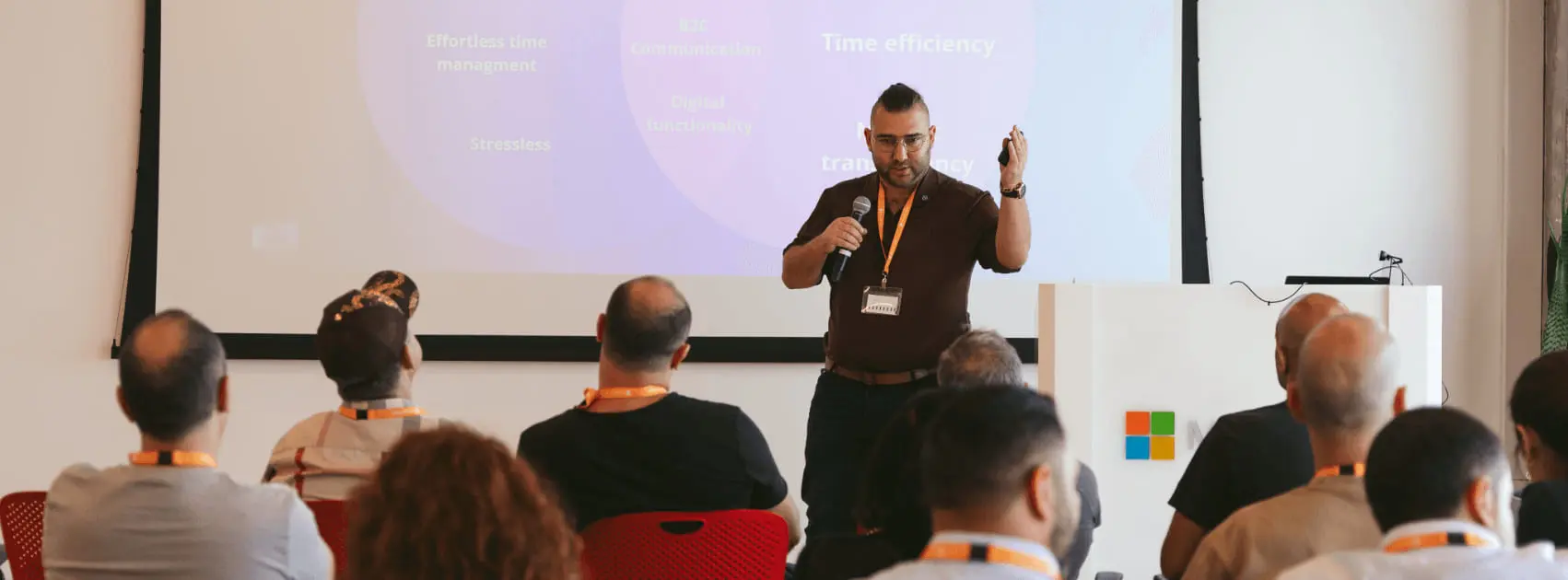
Meeting with international teams, as part of work with a startup
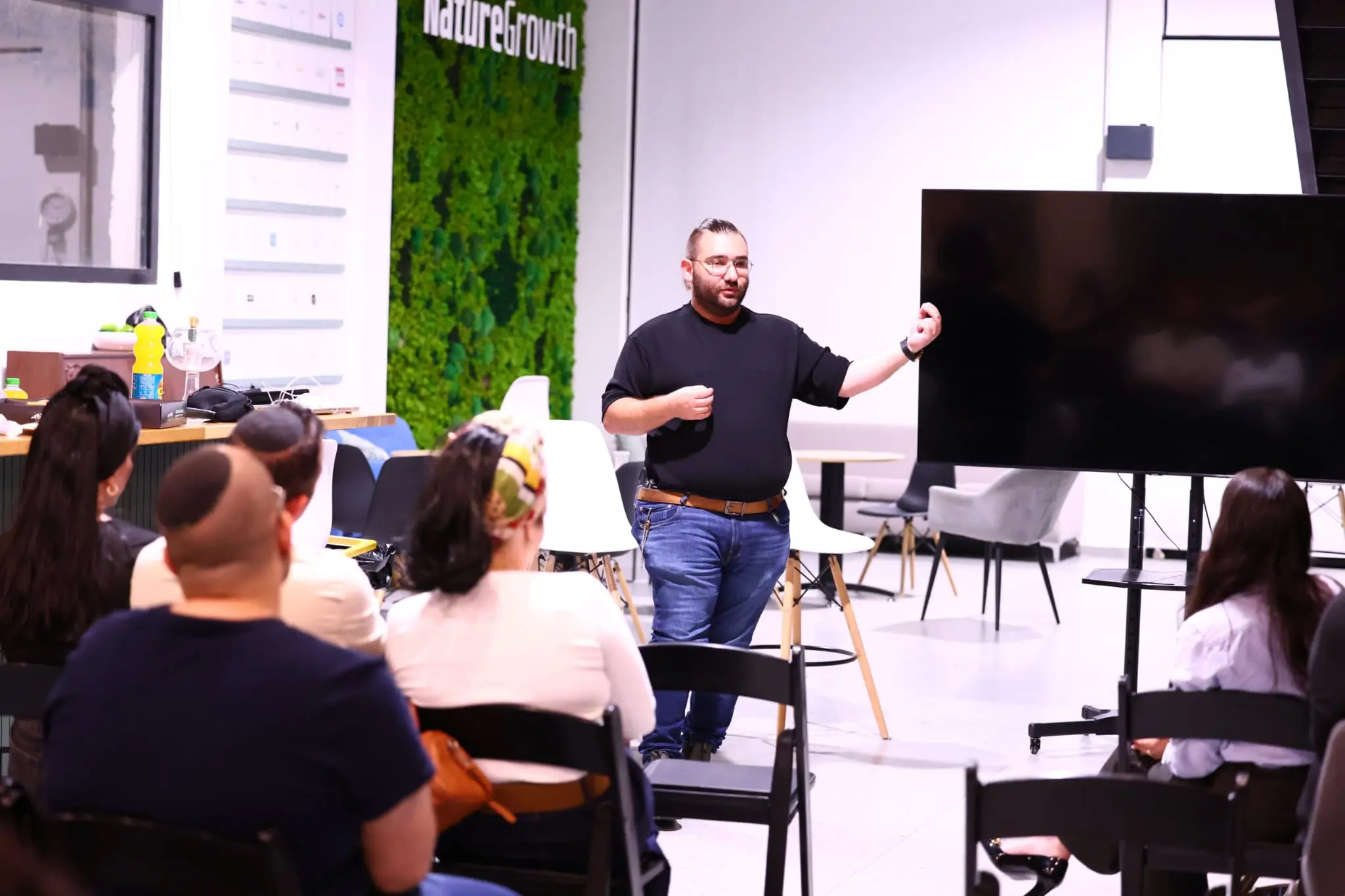
Entrepreneurs session, Sderot
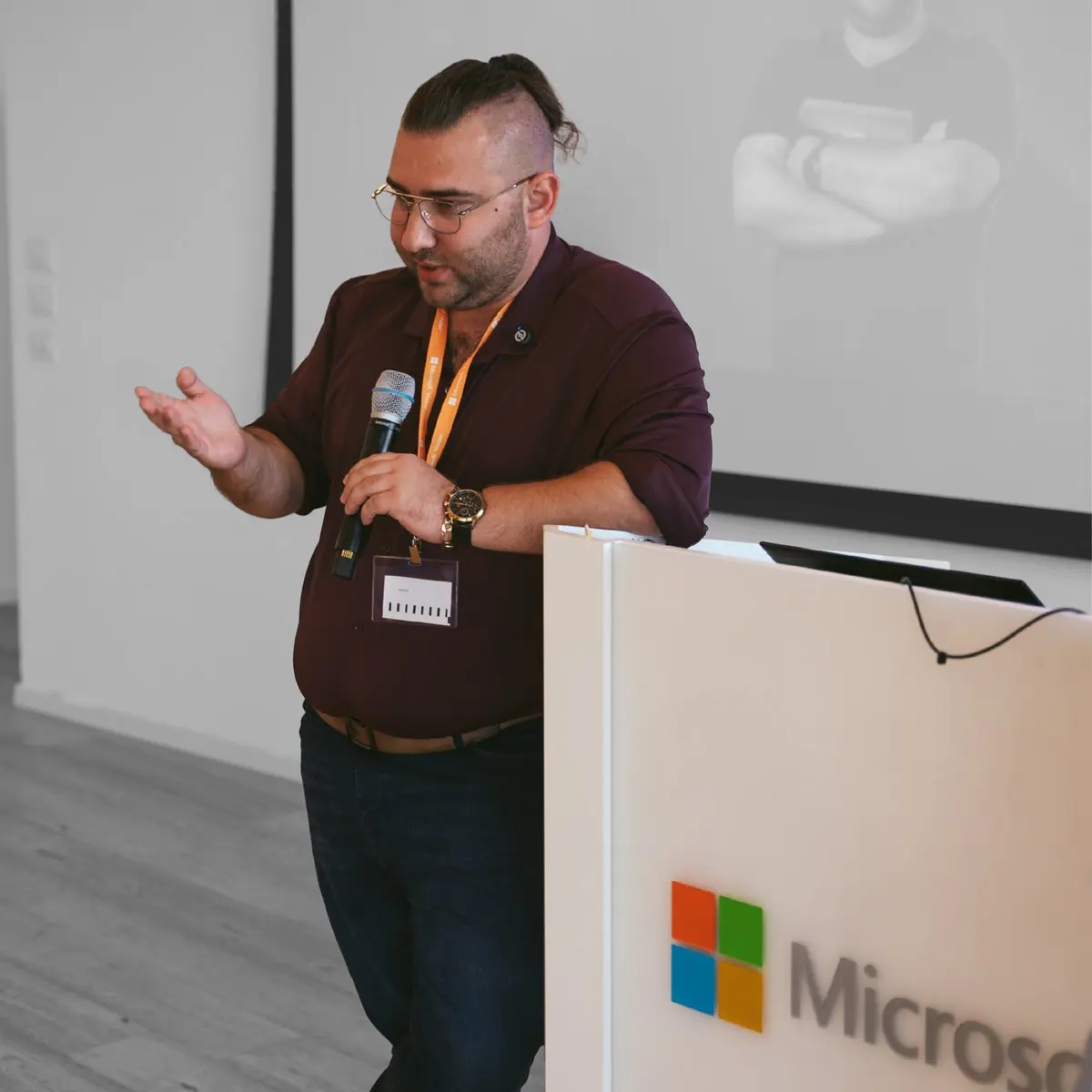
Speaking at Microsoft
What actually happens on the call
No surprises. This is how the call goes.
You tell me where the business stands today. Nothing to prepare, no slides, no documents.
We look at the numbers together, and at whatever is bothering you most right now.
I tell you what I would do first, and what I would deliberately leave for later.
You decide whether there is a next step. Nothing continues automatically, and there is no pitch at the end.
Simplified illustration
The intro call, as one road
- 1
You tell
Where the business stands, in your own words
- 2
I ask
About the numbers, and what bothers you most
- 3
We see together whether it fits
And if it does, how
- 4
What you leave with
What I would do first, and what can wait
- 5
You decide
Whether there is a next step. Nothing continues on its own
- Your part
- The decision, and it stays yours
What happens on the first call, in order: you tell me where the business stands, I ask, we see together whether and how my work fits, you leave with what I would do first, and you decide whether there is a next step.
Simplified. A real call follows what you bring: the questions depend on the stage your business is in, and if I have nothing useful to add, I say so on the call.
mobiusbiz.co.il
And if you're still on the fence
- There's nothing to prepare. All it takes is 15 to 30 minutes.
- The business doesn't have to be in order. For most people it isn't.
- Even if there's no business yet, that's perfectly fine.
- If I have nothing useful to add, I say so on the call, and I don't charge you a shekel.
I have worked with
- Google for Startups
- House of Business, Sderot Municipality
- Microsoft Reactor
- GameReady
- Eclipse Capital
- SderoTech
- IUCEL
- Resilience & Health Innovation Hub
- International Resilience Institute of Sderot


















- Google for Startups
- House of Business, Sderot Municipality
- Microsoft Reactor
- GameReady
- Eclipse Capital
- SderoTech
- IUCEL
- Resilience & Health Innovation Hub
- International Resilience Institute of Sderot
Alexander Slutsker
Entrepreneur and business consultant. Two degrees in business administration, one of them an MBA with a specialization in Entrepreneurship and Hi-Tech. I have guided entrepreneurs, small businesses and startups through opening, running and growing a business. I work professionally in finance, marketing, operations and strategy.
And the paperwork, for anyone who wants to see that too.

Certificate of appreciation, Sderot municipality

Certificate of honor, Teenovation 2026

Directors and officeholders course, SRI Campus
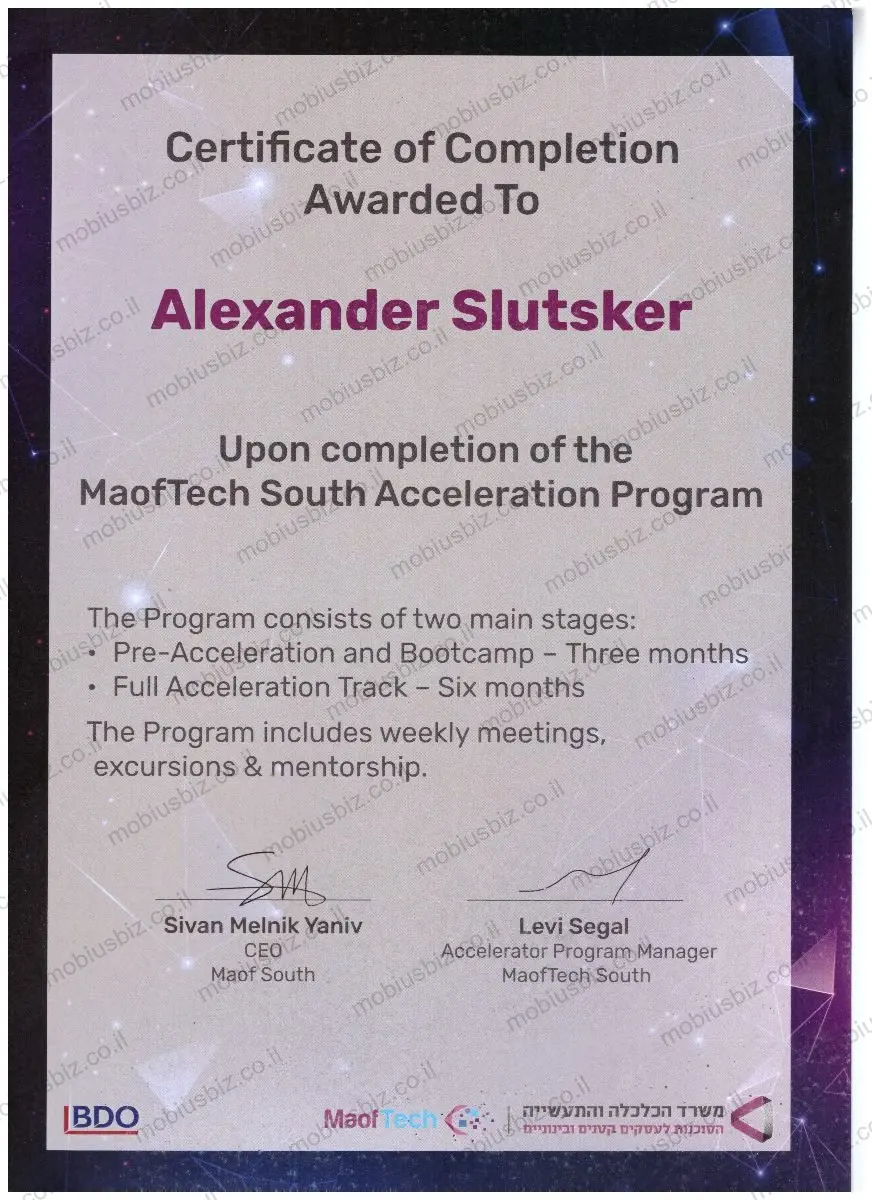
Acceleration program, MaofTech South

Business consultants course

Adaptive project management, INT college
What the work covers
These are the areas I work in. Which of them we actually use depends on what your business needs.
- Financial consulting
- Marketing consulting
- Operations consulting
- Debt and credit
- Strategy
And what I'm not
I'm not a mentor and I'm not a guru. I'm not here to sell you one method, an agenda, a course, a loan, or a solution that supposedly fits everyone.
What I am here to do is stand beside you, understand your situation, the numbers, the needs and the goals, and help you make better decisions. The way I see it, the success of my clients is the measure of my own.
- How long before I see results?
- Not from the first meeting, and not from the first few. First we have to understand where the business really stands, so the effort goes only where it works and nothing that already works gets broken. When measurable, steady results come depends on the business and on the pace of the work. After a first conversation I can tell you what to expect in your field.
- How much of my time will it take?
- A meeting of about an hour, as often as the business needs, and a little more at the start while I learn the business. The rest is carrying out the plan, and that is work you would be doing in your business anyway, not time spent in meetings.
- What happens to the numbers I show you?
- Whatever you show me about your business stays between the two of us, exactly as it does for every other client of mine.
- What kinds of businesses do you work with?
- I have worked with self-employed professionals, small businesses and startups, in beauty and wellness, the trades, food, retail, manufacturing, education, hi-tech and real estate investment, in Israel and abroad. Your trade matters less than your stage. A bakery and a software company at the same stage are usually stuck on the same thing.
Questions people have already asked me
How much does it cost?
The first call costs nothing. There is no bill at the end, and no commitment to continue.
And if we carry on working together, what does that cost?
There is no single number, because it is not the same work. Someone who has not opened yet, a self-employed person who wants to grow, a small business with a few employees, and a startup running on investor money with teams across several departments are in completely different places, both in time pressure and in what actually needs doing. The price follows the stage the business is in, the problem itself, and how much of me you genuinely need. It is also worth knowing what working with me looks like. It is not a weekly meeting with tips. It is working together, teaching you the parts you do not know yet, and walking the steps with you until they happen. We talk about your situation on the first call, and only then can I say anything real about scope and cost. Your success is what makes this work worth doing.
I'm still not sure a consultant is for me at all.
Then this is exactly the right call. In 15 to 30 minutes you will know yes or no, and you pay nothing for the answer.
And what if you can't help me?
Then I say so on the call itself, straight out. I do not take on work I am not the right person for.
How does the call itself work?
A call of 15 to 30 minutes, by phone or on video through Zoom or Google Meet, whichever suits you. There is nowhere to travel. I work remotely with businesses across Israel. A face to face meeting is possible too, for an additional fee.
one consultant
Why I limit how many businesses I work with
I'm one person, not a firm, and my time is as limited as anyone's. Every business I work with gets me, which is why I work with a small number of businesses at a time.
And you don't have to guess whether I have room.
The fastest way to find out is to just ask me.
The message comes straight to me, and I'm the one who answers it.
+972 055-248-6151. Other ways to reach me
You won't find a countdown clock here, or a fake number of spots left. When I have no room, I'll tell you in the first message.

No call center, no sales team. If you wrote and didn't hear back right away, I'm probably in a meeting, and I'll get back to you.
I'm from the south, I live in one of the communities on the Gaza border, and I'm proud of it.
Alexander
Let's start with a conversation
15 to 30 minutes, free, and no obligation. If I can't help, I'll tell you on the call.
The message comes straight to me, and I'm the one who answers it.
+972 055-248-6151. Better on WhatsApp: I am in meetings most of the day and answer as soon as I am free. Other ways to reach me
You can also find me on LinkedIn
Alexander Slutsker
Entrepreneur and business consultant. Two degrees in business administration, hands-on with businesses and startups.
Mobius Business Solutions. Working remotely with businesses across Israel.